FREE INTERACTIVE TOOL
Water Intake Calculator: Estimate Your Daily Fluid Needs
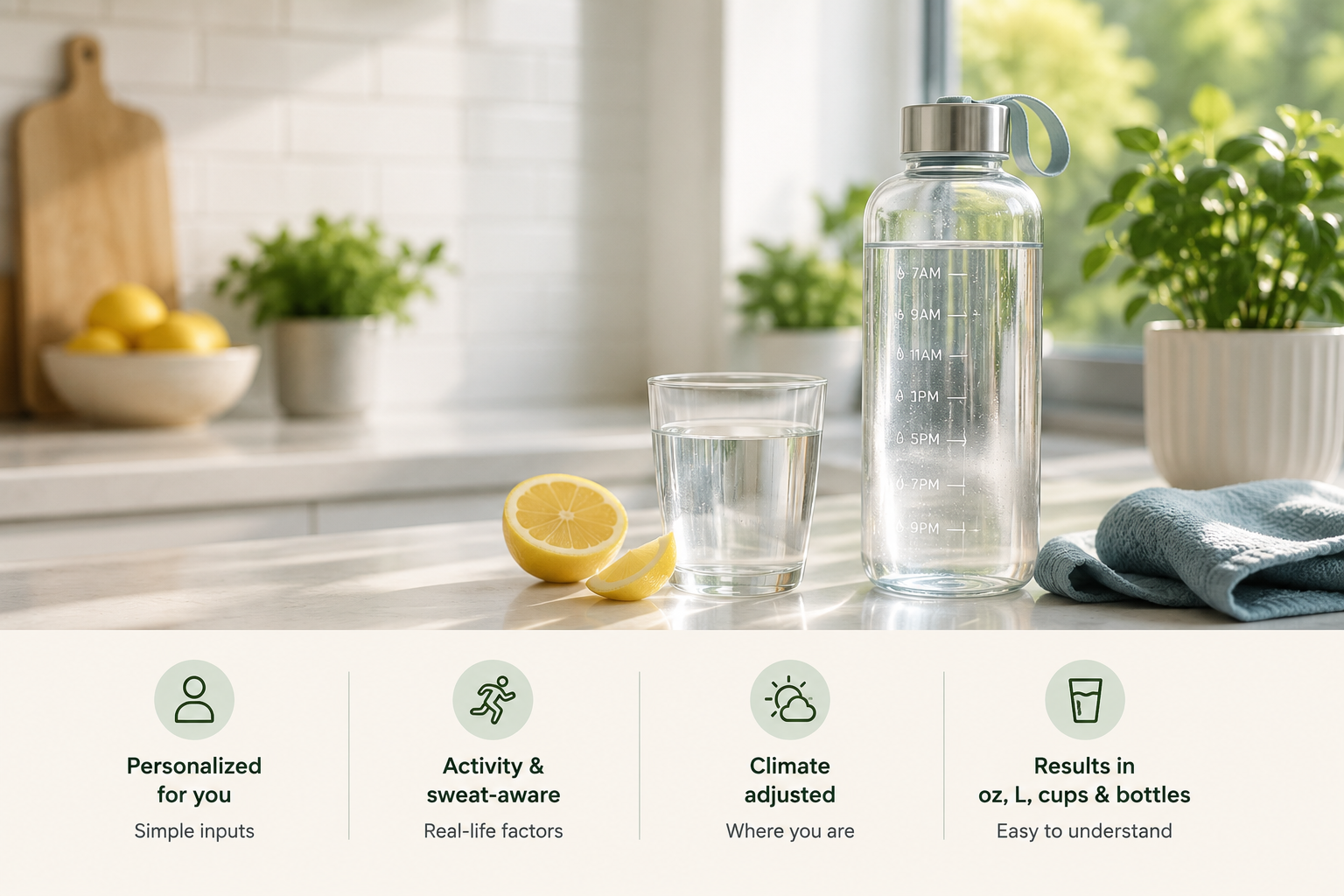
Use this free water intake calculator to estimate a practical daily hydration target. Your result adjusts for body size, age, gender, activity level, and climate.
For adults age 18+. This calculator provides general educational information, not individualized medical advice.
Find Your Daily Water Target
Enter a few everyday details to estimate a practical daily hydration target. Your result adjusts for body size, activity, and climate.
- Supports imperial and metric units
- Adjusts for activity and climate
- Shows ounces, liters, cups, and bottle equivalents
Your calculator selections are processed in your browser and are not submitted as a form.
Your hydration estimate will appear here.
Practical body-weight hydration heuristic · External context: National Academies · CDC · ACSM
Evidence Behind This Calculator
Calculator Method
The calculation used by this tool is a practical planning heuristic created for this calculator. It is not a National Academies, CDC, or ACSM formula. The base estimate starts from body weight (weight in pounds × 0.5 oz), then applies small planning adjustments for sex used by the calculator, age range, weekly activity level, and climate. These adjustments are part of the calculator's planning model rather than an official government equation.
External Context
The authority sources referenced on this page — the National Academies, CDC, and ACSM — provide broader hydration context and safety guidance. They do not specifically endorse the body-weight heuristic or the gender, age, activity, and climate multipliers used by this calculator. The result is a general wellness planning estimate, not individualized medical advice.
Calculator at a Glance
- Primary method
- Body-weight-based practical planning heuristic
- Primary output
- Estimated daily fluid target
- Inputs
- Weight, age, sex used by calculator, activity, climate
- Units
- oz, liters, cups, bottles
- Calculation
- Runs locally in browser
- Account required
- No
- Important limitation
- General planning estimate, not individualized hydration advice
Worked Example
Example profile
160 lb male · Age 35 · Moderate activity · Temperate climate
Base: 160 × 0.5 = 80 oz
Adjustments: 80 × 1.05 (male) × 1.00 (age 18–39) × 1.15 (moderate) × 1.00 (temperate)
Result: ≈ 97 oz/day
Example only — not a universal hydration recommendation.
What This Calculator Cannot Know
A body-weight heuristic cannot directly account for medical conditions, medications, pregnancy or breastfeeding, exact sweat loss, fever or illness, altitude, exact dietary water intake, individual electrolyte needs, or clinician-directed fluid restrictions. If a healthcare professional has given you a specific fluid plan, follow that guidance instead.
Why This Result?
Baseline Reference
The starting value comes from a practical body-weight hydration heuristic (weight × 0.5 oz).
Activity Planning
Your weekly activity level adjusts the planning estimate upward to account for exercise-related fluid needs.
Climate Context
Temperate conditions use the standard planning estimate.
Food Counts Too
Food contributes to total water intake, which is why your result is a planning estimate rather than an exact amount of plain water.
What Counts Toward Daily Fluid Intake?
Water is an excellent calorie-free choice, but other beverages and water-rich foods also contribute to total fluid intake.
Milk and other beverages also contribute. Not all beverages are nutritionally equivalent.
Simple Ways to Make Hydration Easier
- Keep water easily accessible
- Carry a reusable bottle when convenient
- Drink according to thirst and conditions
- Pay extra attention during heat or physical activity
- Include water-rich foods
- Follow individualized clinician guidance if you have been given a fluid plan
How Does This Water Intake Calculator Use Body Weight?
Body weight provides the starting point for the practical hydration estimate. The calculator then adjusts the planning estimate based on age, gender, activity level, and climate. This is a practical planning heuristic rather than an exact medical requirement.
Many people search for a water intake calculator by weight because body size is one of the most intuitive factors in daily fluid needs. This calculator uses weight as the primary driver while keeping the overall estimate practical and adjustable for everyday conditions.
How This Water Intake Calculator Works
The calculation used by this tool is a practical planning heuristic created for this calculator. It is not a National Academies, CDC, or ACSM formula. Those organizations provide broader hydration context and safety guidance, while this calculator combines body weight and lifestyle factors into a practical planning estimate.
- 1This calculator uses a practical body-weight-based hydration heuristic and adjusts the estimate using general activity and climate planning factors.
- 2The base estimate starts from body weight (weight_lbs × 0.5 oz).
- 3Small planning adjustments are applied for gender and age.
- 4Weekly activity level adjusts the estimate upward to reflect exercise-related fluid needs.
- 5Climate adjusts the estimate: cold slightly lowers it, temperate keeps the standard, and hot/tropical raises it.
- 6Food and other beverages also contribute to total fluid intake, which is why the result is a planning estimate rather than an exact amount of plain water.
- 7Output is a general wellness planning estimate, not a medical prescription.
Important: Fluid Needs Vary
This calculator provides a general wellness planning estimate for adults. Actual fluid needs can vary with medical conditions, medications, pregnancy, breastfeeding, illness, sweating, exercise, extreme heat, and individual physiology.
If a healthcare professional has prescribed a fluid restriction or individualized plan, follow that guidance instead. Drinking excessive amounts of water too quickly can be harmful.
Frequently Asked Questions
How much water should I drink a day?
This calculator estimates a practical daily hydration target based on your body weight, age, gender, activity level, and climate. It provides a general wellness planning estimate, not an exact medical requirement.
How does body weight affect water intake?
Body weight provides the starting point for the estimate. The calculator uses a practical body-weight heuristic and then adjusts the planning estimate based on age, gender, activity, and climate.
Does age affect the calculation?
Yes, modestly. The calculator applies a small planning adjustment for age bands (18–39, 40–64, 65+). This is only a calculator adjustment — thirst sensation and medical circumstances can differ with age, and clinician guidance takes priority.
Does gender affect the calculation?
Yes. The calculator applies a small gender planning adjustment. This is a heuristic for general planning and is not a medically precise requirement.
Does exercise increase my water target?
Yes. Higher weekly activity levels increase the planning estimate because physical activity and sweating can raise fluid needs above the baseline.
Does climate affect how much water I should drink?
Yes. Hot or tropical conditions increase the planning estimate, while cold conditions may slightly reduce it. Every climate selection visibly affects the result.
Why does hot weather increase my result?
Hot or humid conditions can increase sweat and fluid losses, so the calculator adjusts the planning estimate upward for hot/tropical climates.
Does coffee count toward hydration?
Yes. Coffee, tea, milk, sparkling water, and other beverages all contribute to daily fluid intake. Water is an excellent calorie-free choice, but it is not the only fluid that counts.
Does food count toward hydration?
Yes. Water naturally present in food—especially fruits and vegetables—contributes to total water intake.
Can drinking too much water be harmful?
Yes. Excessive water intake in a short period can be harmful. This calculator provides a general daily planning estimate, not a prescription to consume a large volume all at once. Drink according to thirst, conditions, and any individualized guidance from a healthcare professional.
Related Tools & Guides
Planning your everyday fluid intake is different from planning emergency household water storage.