HOUSEHOLD EMERGENCY WATER GUIDE
Emergency Water Supply for Home: How to Build a Practical Backup Plan
Learn how to estimate your household water needs, choose storage options, keep water safer, plan treatment and filtration, and build backup layers for unexpected water disruptions.
Free interactive 14-Day Family Water Backup Planner
Independent educational guide • Practical household planning • Water safety matters
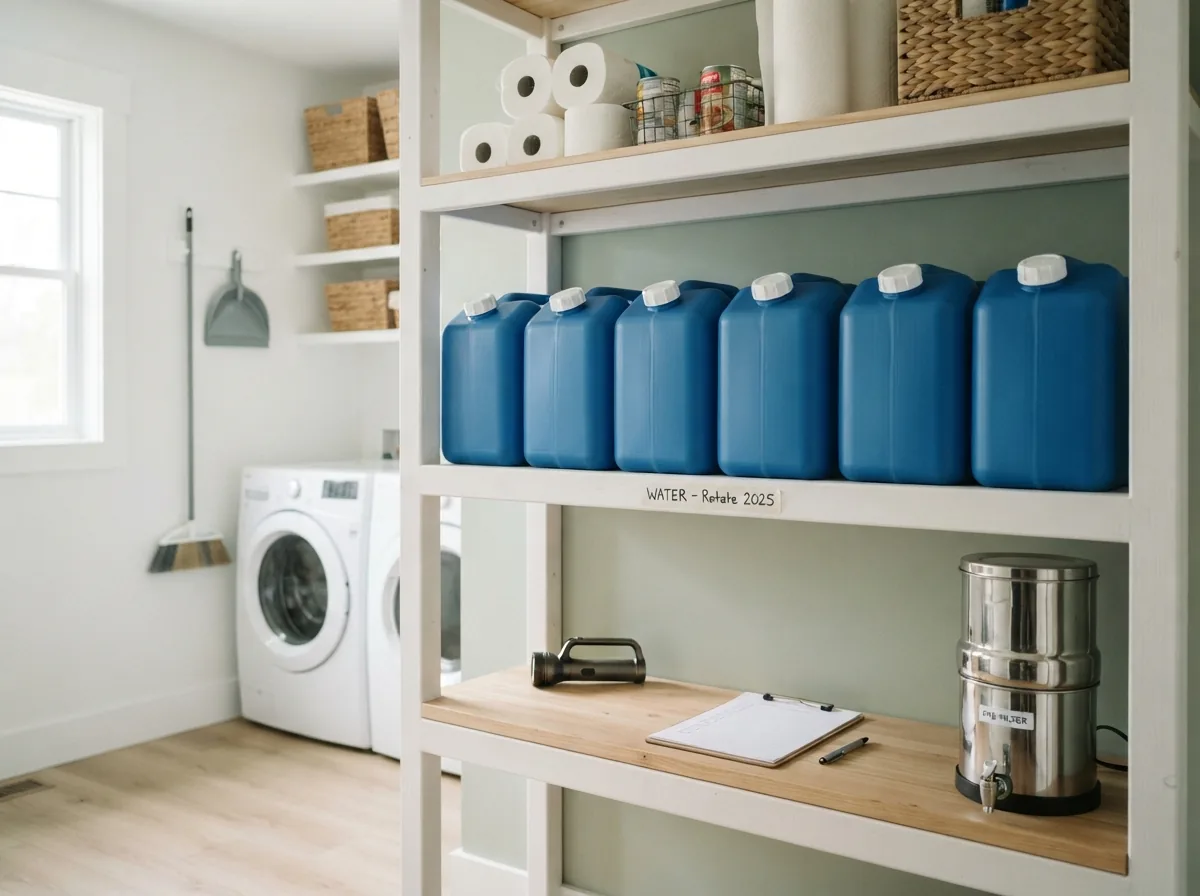
What Is an Emergency Water Supply?
An emergency water supply is water and related backup equipment a household keeps or can access when normal water service is interrupted. A practical plan may include stored drinking water, water for basic household needs, clean storage containers, treatment or filtration options, backup sources, and a household response plan. Needs vary by household and situation, so the most useful plans are tailored to your specific circumstances rather than copied from a generic template.
How Much Emergency Water Does Your Household Need?
There is no single number that fits every household. Planning depends on several factors that interact with each other:
Number of people
More household members means more daily water usage across drinking, cooking, and hygiene.
Duration
Planning for three days differs significantly from planning for two weeks. The longer the potential interruption, the more water you need stored.
Climate
Hot or dry conditions increase drinking-water needs. Cold climates may introduce freeze-protection concerns for stored water.
Children
Children may have different hydration needs and may require specific preparation methods for formula or food.
Older adults
Older household members may have additional hydration or medication-related water requirements.
Pregnancy
Pregnant individuals may have increased water needs. Consult appropriate health guidance for specific recommendations.
Medical or personal needs
Some medical conditions, treatments, or equipment may require additional water or specific water quality.
Pets
Animals need water too. Include all pets in your household calculation — their needs add up over days.
Cooking
Food preparation often requires water beyond what is needed for drinking alone.
Basic hygiene
Handwashing and basic sanitation help reduce illness during disruptions and require their own water allocation.
The CDC emergency water supply guidance recommends storing at least one gallon of water per person per day for emergencies, covering drinking and basic sanitation. However, that figure is a baseline — your actual needs may be higher depending on the factors above. Rather than replacing a proper calculation with a static estimate, the most useful approach is to calculate a target based on your actual household.
FREE INTERACTIVE TOOL
Calculate Your Household's 14-Day Water Target
Use the free 14-Day Family Water Backup Planner to estimate your household target, compare it with what you currently have stored, calculate your current gap, and create a practical action plan.
Build My Free Water Plan →- Personalized household water target
- Current water-gap calculation
- Water Readiness Score
- Storage planning
- Treatment planning
- Backup-source planning
- Personalized 14-day action plan
Start With Stored Water
Stored water is generally the most predictable first layer in any emergency water plan. When properly stored, it requires no power, no equipment, and no alternative source to access. You know what it is, where it is, and how much you have.
The main advantages of stored water are immediate availability and known source quality. You do not need to wait for equipment to start, depend on weather conditions, or worry about whether a source is accessible. The trade-off is space — water is heavy and bulky, and storing enough for a longer disruption requires planning and rotation.
Key considerations for stored water include:
- Availability: Stored water is ready when you need it, with no startup time or dependency.
- Immediate access: No power, pumps, or processing required — just open the container.
- Known source: When properly stored in clean, food-safe containers, you know the origin and condition of your water.
- Space limitations: Water takes up significant space. Plan storage locations carefully, especially in smaller homes or apartments.
- Rotation and inspection: Stored water should be checked periodically and rotated as needed to maintain quality.
What Containers Should You Use for Emergency Water?
The containers you choose matter. Not every plastic container is suitable for storing drinking water. Containers should be food-safe, clean, sealable, and designed for water storage.
- Food-safe containers: Use containers specifically labeled as food-grade or designed for water storage. These are made from materials that do not leach harmful substances into water.
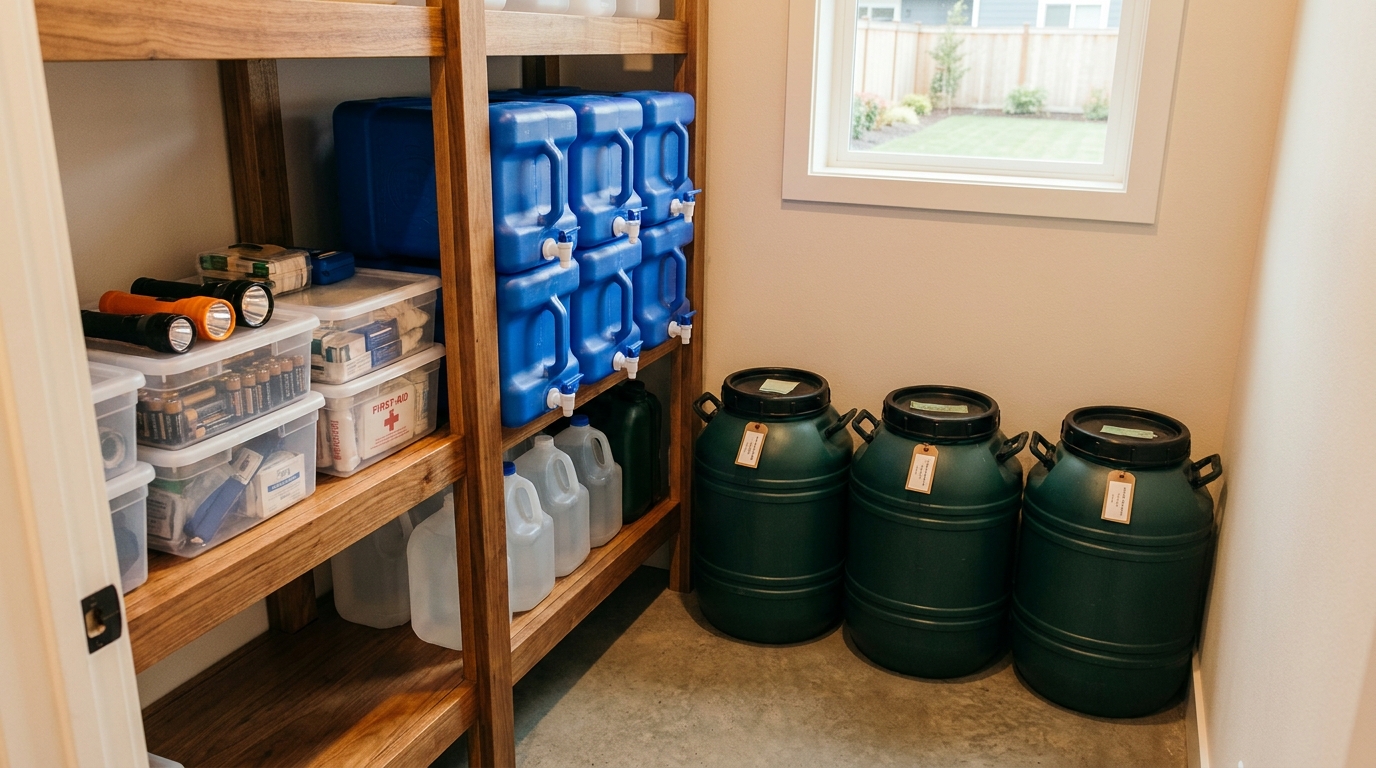
- Purpose-built water storage containers: Rigid water bricks, jerry cans, and barrel-style containers designed for emergency water storage are widely available and often stackable.
- Cleaning: Wash containers with soap and water, then sanitize before filling. Follow manufacturer cleaning instructions.
- Sealing: Containers should seal tightly to prevent contamination from air, insects, or surrounding materials.
- Labeling: Label containers with the fill date so you can track rotation and inspection schedules.
- Storage location: Choose a location that is cool, dark, and away from chemicals or heat sources.
- Avoiding unsuitable containers: Do not use containers that previously held milk, juice, chemicals, or non-food substances. Residues can be difficult to remove and may contaminate stored water.
WaterStorageCube Collapsible Water Container with Spigot — 2.6 Gal, 2-Pack
Collapsible water containers can provide flexible short-term storage when portability and limited storage space matter.
Check Current Price →Disclosure: This section contains affiliate links. As an Amazon Associate I earn from qualifying purchases.
Using a Bathtub for Emergency Water Storage
A bathtub water-storage bladder can provide a larger temporary household water reserve when you have advance warning of a disruption. These bladders are designed to be placed in a standard bathtub and filled before water service becomes contaminated or unavailable.
There is an important difference between water stored directly in a bathtub and water stored inside a dedicated food-grade bathtub bladder:
- Water in a bathtub bladder: A food-grade bladder keeps water separated from the bathtub surface, reducing exposure to contaminants and providing a sealed, covered storage environment.
- Water directly in a bathtub: A bare bathtub surface may contain residues, cleaning chemicals, and microorganisms. Water stored directly is exposed and should not be assumed safe to drink without appropriate treatment.
Bathtub Water Is Not Automatically Safe
Bathtub Emergency Water Storage Bladder Up To 100 Gallon Capacity
A bathtub water-storage bladder can provide a larger temporary household water reserve when deployed according to its instructions before a disruption.
Check Current Price →Disclosure: This section contains affiliate links. As an Amazon Associate I earn from qualifying purchases. Actual usable capacity depends on the product specifications and your bathtub size. Do not treat stated capacity as a guaranteed usable amount without considering your specific bathtub dimensions.
Where Should Emergency Water Be Stored?
Storage location affects both water quality and container longevity. Consider these factors when choosing where to keep your emergency water:
- Cool location: Heat can degrade container materials and affect water quality over time. Choose the coolest practical location in your home.
- Away from direct sunlight: UV exposure can weaken plastic containers and promote microbial growth. Dark or shaded storage is preferable.
- Away from chemicals: Store water away from gasoline, pesticides, cleaning supplies, and other substances that could contaminate containers through vapors or spills.
- Protection from freezing: Frozen water expands and can crack containers. In cold climates, protect stored water from freezing temperatures.
- Container accessibility: Store water where you can easily reach it and inspect it periodically.
- Weight: Water weighs approximately 8.3 pounds per gallon. Consider floor and shelf load capacity, especially for larger quantities.
- Multiple locations: Where practical, storing water in more than one location provides redundancy if one area becomes inaccessible.
How Long Can Emergency Water Be Stored?
There is no universal expiration date for stored water. How long water remains safe depends on the source, container, treatment, storage conditions, and whether the container has been opened.
- Commercially packaged emergency water: May have a manufacturer-specified shelf life. Follow the packaging guidance for storage and replacement.
- Properly stored household water: When stored in clean, sealed, food-safe containers under good conditions, water can remain usable for extended periods — but it should be inspected and rotated periodically.
- Opened containers: Once a container is opened, water is exposed to air and potential contaminants. Use opened water promptly or treat it before consumption.
- Contaminated storage: If a container shows signs of contamination — odor, discoloration, or visible growth — do not consume the water. Empty, clean, and sanitize the container before refilling.
Storage recommendations vary by source, container type, treatment method, and authoritative guidance. Follow applicable public-health guidance and container or manufacturer instructions rather than assuming a single universal shelf life.
Should Emergency Water Be Rotated?
Periodic rotation is good practice, but there is no single rigid schedule that applies to every situation. Rotation frequency depends on your container type, storage conditions, treatment method, and local recommendations.
A practical rotation approach includes:
- Inspection: Check containers periodically for cracks, leaks, or signs of degradation.
- Container condition: Look for discoloration, warping, or damage that could compromise the seal or water quality.
- Odor or contamination concerns: If water has an unusual odor, taste, or appearance, do not consume it. Empty and clean the container before refilling.
- Labeling dates: Label containers with the fill date so you can track how long water has been stored.
- Following authoritative recommendations: Follow applicable public-health guidance and manufacturer instructions for rotation frequency.
What If Your Stored Water Runs Out?
A practical emergency water plan does not end with stored water. If your stored supply runs low, a layered approach provides backup options:
- Stored water: Your first and most predictable layer.
- Treatment capability: The ability to make water from alternative sources safer to use.
- Filtration: Portable or household filtration as a backup treatment method.
- Alternative sources: Rainwater collection, a well, atmospheric water generation, or other local options.
- Community or public distribution: Emergency water distribution points may be available during larger disruptions.
- Backup power: If your alternative source requires electricity — such as a well pump — backup power keeps it running.
The goal is redundancy. No single backup method is perfect for every situation, which is why combining several approaches is more resilient than relying on one.
Water Treatment vs Water Filtration
Filtration and treatment are not the same thing. Different methods address different risks, and understanding the distinction helps you choose the right approach for your situation.
Filtration
Filtration physically removes particles, sediment, and some contaminants by passing water through a filter medium. Different filters address different particle sizes and contaminants. No single filter handles every possible substance.
Treatment / Disinfection
Treatment or disinfection targets microorganisms through chemical treatment, UV light, boiling, or other methods. Treatment does not remove chemical contaminants or sediment — it addresses biological risks. The two processes are often used together.
No single method handles every situation. A practical plan may combine sediment removal, filtration, and disinfection depending on the water source and the contaminants of concern. For general disinfection context, see EPA emergency drinking-water guidance. Specialized treatment may be needed for specific chemical contaminants that standard filtration and disinfection do not address.
Aquatabs Water Purification Tablets, 397mg 100 Pack
Water-treatment tablets can be one component of an emergency plan when used according to their directions and when appropriate for the water source being treated.
Check Current Price →Disclosure: This section contains affiliate links. As an Amazon Associate I earn from qualifying purchases. Water-treatment tablets do not remove every possible contaminant and should not be assumed to make every unknown water source safe. Follow product instructions and applicable public-health guidance.
Portable Water Filters as a Backup Layer
Portable water filters can serve as a useful backup layer, but they are not a complete household water strategy on their own. Their role is complementary — providing filtration when your primary household treatment system is unavailable or when you need to treat water from an alternative source.
Portable filtration may be appropriate for:
- Emergency backup: A fallback if your primary household filtration system fails or needs maintenance.
- Travel or evacuation: Compact filtration you can take with you if you need to leave your home.
- Temporary source use: Treating water from an alternative source when your main system is down.
- Secondary backup: An additional treatment option alongside your primary household method.
Portable filters should not be presented as the entire household water strategy. They are a complement to — not a replacement for — properly stored water and a well-designed household treatment plan.
5 High-Capacity Emergency Water Straws
Portable filtration straws can provide an additional emergency filtration option when other water-treatment systems are unavailable.
Check Current Price →Disclosure: This section contains affiliate links. As an Amazon Associate I earn from qualifying purchases. Portable filtration straws do not treat every contaminant and should not be relied on as a sole household water treatment solution.
How Can You Check Water Quality?
Visual appearance and odor are not reliable indicators of water safety. Water that looks clear and has no smell may still contain contaminants that are not detectable by human senses.
- Visual appearance is insufficient: Clear water does not mean safe water. Many contaminants — including microorganisms and chemical substances — are invisible.
- Odor is insufficient: The absence of unusual smell does not confirm that water is safe to drink.
- Source history matters: Knowing where water came from and how it was stored helps you assess potential risks.
- Consumer test kits have limitations: At-home test kits can screen for several common water characteristics, but they do not detect every possible contaminant and should not be treated as proof that water is completely safe.
- Laboratory testing may be appropriate: For a more comprehensive assessment, professional laboratory testing may be appropriate, especially if the water source is unknown or potentially contaminated.
- Public-health advisories override assumptions: If local authorities issue a boil-water advisory or other guidance, follow that guidance regardless of how the water looks or smells.
17-in-1 Complete Drinking Water Test Kit
A consumer water-testing kit may help screen several common water characteristics, but it does not prove that an unknown water source is completely safe or replace professional laboratory testing when appropriate.
Check Current Price →Disclosure: This section contains affiliate links. As an Amazon Associate I earn from qualifying purchases. A consumer test kit does not replace professional laboratory testing where laboratory analysis is appropriate.
What Should You Do If Your Home Suddenly Has No Water?
A sudden loss of water can be disorienting, but a few practical steps can help you respond calmly and safely:
- 1
Determine the scope of the interruption.
Check whether the issue affects only your home or a larger area. A single-home issue may be a plumbing problem; a wider issue may be a utility disruption.
- 2
Check official local notices.
Look for alerts from your water utility or local government. These may explain the cause, expected duration, and any safety guidance.
- 3
Protect your stored drinking water.
Use your stored water according to household priorities — drinking and essential hygiene first.
- 4
Avoid assuming uncertain sources are potable.
Do not drink water from sources you are unsure about without appropriate treatment.
- 5
Use stored water according to household priorities.
Prioritize drinking, food preparation, and essential hygiene. Reduce non-essential water use until service is restored.
- 6
Follow boil-water or other public-health advisories.
If authorities issue specific guidance, follow it — even if your water appears normal.
- 7
Identify safe community resources if needed.
During larger disruptions, emergency water distribution points or community resources may be available.
Emergency Water for Drinking vs Other Household Uses
Different activities have different water-quality requirements. During a disruption, it helps to think about water in categories rather than treating all water the same way.
- Drinking: Requires the highest quality water. Use your stored drinking water or properly treated water for consumption.
- Food preparation: Water used for cooking, mixing, or washing food that will be consumed should meet drinking-water standards.
- Basic hygiene: Handwashing and basic personal hygiene require reasonably clean water but do not necessarily need the same quality as drinking water.
- Cleaning: General cleaning and surface wiping can use lower-quality water where health risk is minimal.
- Sanitation: Toilet flushing can often use non-potable water, such as rainwater or gray water, where available.
- Pets: Pets need clean drinking water. Include their needs in your household calculation.
Do Not Use Unsafe Water Where Health Risk Exists
Emergency Water Planning for Children, Older Adults, Pets, and Special Needs
A one-size-fits-all water plan does not work for every household. Plans should account for the specific needs of all household members:
- Children: Children may have different hydration needs and may require specific preparation methods for formula or food. Include enough water for their daily requirements.
- Older adults: Older household members may have additional hydration needs, mobility limitations that affect access to stored water, or medication requirements that involve water.
- Mobility limitations: Household members with mobility limitations may need water stored in easily accessible locations.
- Medical equipment or personal needs: Some medical conditions or treatments may require additional water or specific water quality. Factor these into your plan.
- Pets: Animals need clean drinking water. Include all pets — dogs, cats, birds, reptiles, and other animals — in your household calculation.
- Medications that require water: Some medications need to be taken with water. Ensure you have enough stored water for medication purposes.
- Special diets: Special dietary needs may affect food preparation water requirements.
This section provides general planning guidance only. It does not provide individualized medical recommendations. Consult appropriate healthcare professionals for specific medical or dietary guidance.
Can Rainwater Be Part of an Emergency Water Supply?
Rainwater can supplement emergency water supplies where legally permitted and practical. However, it requires proper collection, storage, and treatment to be used safely.
- Collection: Rainwater is typically collected from roof surfaces through gutters and downspouts. Collection surfaces affect water quality.
- Storage: Collected rainwater should be stored in clean, covered, food-safe containers to prevent contamination.
- Roof contamination: Roof surfaces may collect bird droppings, dust, debris, and chemical residues. First-flush diverters can help reduce initial contamination.
- Treatment: Roof-collected rainwater should not be assumed automatically safe to drink. Filtration and disinfection may be needed depending on the source and intended use.
- Seasonality: Rainfall varies by season and region. Rainwater is not a reliable year-round source in all climates.
- Local rules: Rainwater collection regulations vary by location. Check what applies in your area before relying on rainwater as a backup source.
Can a Well Be a Backup Water Source?
A private well can provide water independent of municipal systems, making it a potential backup source during utility disruptions. However, wells come with their own requirements and limitations:
- Power dependence: Most wells require electric power for pumping. During a power outage, a well may not function without backup power such as a generator or battery system.
- Pump: Well pumps are mechanical devices that require maintenance and may fail. A backup pump or manual pump option provides redundancy.
- Water quality: Well water quality should be tested regularly. Groundwater conditions can change over time.
- Testing: Regular water-quality testing is important for any private well. Follow local recommendations for testing frequency.
- Well availability: Well yield can vary seasonally. A well that provides adequate water in spring may produce less during dry periods.
- Backup power: If your well depends on electricity, plan for backup power to maintain water access during outages.
For a broader look at independent water systems, see our off-grid water system guide.
Can You Make Emergency Water From Air?
Atmospheric water generation can potentially serve as one secondary backup source within a broader emergency water plan. It is not a replacement for stored water, but it may provide supplemental water in the right conditions.
Key considerations include:
- Humidity: Output depends heavily on relative humidity. Dry climates produce much less water than humid ones.
- Temperature: Temperature affects how much moisture the air holds and how efficiently condensation works.
- Power: Most condensation-based systems require electricity, which may be unavailable during an emergency unless you have backup power.
- Equipment: Whether DIY or commercial, the system must be sized and maintained for your conditions.
- Variable output: Do not expect a fixed daily output. Production changes with environmental conditions.
- Treatment: Collected water should not be assumed safe to drink without appropriate treatment and testing.
- Maintenance: Collection surfaces, filters, and storage components require regular cleaning.
For more detail, see our guides on how to make water from air, atmospheric water generator for home use, and the DIY atmospheric water generator guide.
Emergency Water Supply vs Off-Grid Water System
These two concepts are related but serve different purposes:
Emergency Water Supply
Short-term resilience when normal water service fails. The focus is on stored water, treatment capability, and backup options to bridge a temporary disruption — typically measured in days or weeks.
Off-Grid Water System
Ongoing water infrastructure designed to operate with less or no municipal dependence. The focus is on a complete system — source, storage, pumping, treatment, and power — for continuous household use.
For a deeper look at full independent water systems, see our off-grid water system guide.
A Layered Emergency Water Plan
A resilient emergency water plan combines multiple layers so that if one falls short, the others still provide value. Redundancy is the core principle.
Layer 1 — Stored Water
A reserve of clean water kept in food-safe containers before any disruption. This is your most reliable immediate resource — no power, no equipment, and no alternative source required.
Layer 2 — Portable Backup Storage
Collapsible containers, bathtub bladders, or other portable options that can expand your reserve quickly when you have advance warning of a disruption.
Layer 3 — Treatment & Filtration
The ability to filter, disinfect, or otherwise make water from any source safer to use. Treatment capability matters as much as storage, because alternative sources may not be automatically safe.
Layer 4 — Alternative Water Sources
Backup ways to obtain water when stored supplies run low — rainwater collection, a well, atmospheric water generation, or community resources, depending on your location and circumstances.
Layer 5 — Household Response Plan
A clear plan covering who does what, how water is prioritized, where supplies are stored, and how the plan is practiced before it is needed.
Emergency Water Checklist for Home
Use this checklist as a starting point. You do not need to do everything at once — work through it gradually and revisit it periodically.
- Calculate your household water target
- Know your current stored amount
- Identify your storage gap
- Use appropriate, food-safe water containers
- Know where your water is stored
- Keep treatment instructions accessible
- Maintain backup filtration where appropriate
- Identify at least one secondary water source
- Consider power needs for pumps or treatment equipment
- Include pets and household-specific needs
- Keep official local information sources accessible
- Review and update the plan periodically
TURN THE CHECKLIST INTO A PLAN
See Exactly Where Your Household Water Plan Stands
The free planner calculates your target, current storage gap, readiness score, and personalized next steps.
Check My Water Readiness →ALTERNATIVE BACKUP WATER IDEA
Interested in Exploring Water-From-Air as an Additional Backup Source?
Stored water and practical treatment options should form the foundation of many household emergency plans. For people interested in exploring another possible backup layer, there is a separate DIY water-from-air presentation you can review.
Consider humidity, temperature, power requirements, maintenance, materials, water treatment, and realistic household demand before deciding whether it fits your situation.
Explore the DIY Water-From-Air Approach →
Affiliate disclosure: We may earn a commission if you purchase through links on this page, at no additional cost to you.
Frequently Asked Questions
How much emergency water should a household store?
The amount depends on your household size, the duration you are planning for, climate, cooking and hygiene needs, pets, and any medical or personal requirements. Rather than relying on a single generic number, use a planning tool to calculate a target that reflects your specific household. Our free 14-Day Family Water Backup Planner can help.
How much emergency water is needed per person?
General public-health guidance often suggests approximately one gallon of water per person per day as a starting point, covering drinking and basic sanitation. However, actual needs vary based on climate, activity level, health conditions, pregnancy, and the duration of the disruption. Use that figure as a baseline and adjust it for your household.
What is the best way to store emergency water?
Store water in clean, food-safe containers designed for water storage. Keep containers sealed, labeled with the storage date, and placed in a cool location away from direct sunlight and chemicals. Avoid containers that previously held non-food substances. Follow container and manufacturer instructions for cleaning and maintenance.
How long can emergency water be stored?
Storage life depends on the container, treatment, storage conditions, and whether the water was commercially packaged or self-stored. Commercially packaged emergency water may have a longer shelf life. Properly stored household water should be inspected and rotated periodically. Follow applicable public-health guidance and container manufacturer instructions rather than assuming a universal expiration date.
Should stored water be rotated?
Yes, periodic rotation is good practice. Inspect containers for damage, check for odor or contamination concerns, and label containers with storage dates. Follow authoritative recommendations for rotation frequency, which may vary based on container type, treatment, and storage conditions.
Where should emergency water be stored?
Store water in a cool, dark location away from direct sunlight, chemicals, and heat sources. Protect containers from freezing. Consider weight when storing large quantities — water is heavy, and floor or shelf load capacity matters. Storing water in multiple locations can provide redundancy if one area becomes inaccessible.
What containers are best for emergency water?
Purpose-built water storage containers, food-grade plastic containers, and commercially packaged emergency water are common options. Containers should be clean, food-safe, sealable, and designed for water storage. Avoid containers that previously held milk, chemicals, or non-food substances, as residues can be difficult to remove and may contaminate water.
Can you store emergency water in a bathtub?
A dedicated food-grade bathtub water-storage bladder can provide a larger temporary reserve when deployed before a disruption. Water stored directly in a bathtub is exposed to surface contaminants and is not the same as water stored in a food-grade bladder. Do not assume untreated bathtub water is safe to drink without appropriate treatment.
How do you make stored water safer to drink?
Making water safer may involve filtration, disinfection, or both, depending on the source and the contaminants of concern. Follow applicable public-health guidance and product instructions for any treatment method you use. No single method addresses every possible contaminant, and water-quality testing can help confirm results.
What is the difference between water filtration and purification?
Filtration physically removes particles and some contaminants by passing water through a filter medium. Purification or disinfection targets microorganisms through chemical treatment, UV light, boiling, or other methods. The two processes address different risks and are often used together. No single method handles every situation.
What should you do if your home suddenly has no water?
First, determine whether the interruption affects only your home or a larger area. Check official local notices. Protect your stored drinking water, avoid assuming uncertain sources are potable, and use stored water according to household priorities. Follow any boil-water or public-health advisories, and identify safe community resources if needed.
What are good backup water sources?
Common backup sources include stored water, rainwater collection where legally permitted, private wells, atmospheric water generation, and community or public distribution points. Each source has different requirements for treatment, equipment, and legal considerations. A layered approach combining several sources is more resilient than relying on one.
Can rainwater be used during an emergency?
Rainwater can supplement emergency supplies where legally permitted and practical. However, roof-collected rainwater may pick up contaminants from collection surfaces and should not be assumed automatically safe to drink. Treatment, storage in food-safe containers, and awareness of local regulations all matter.
Can a well be used during a power outage?
A private well can provide water independent of municipal systems, but most wells require electric power for pumping. During a power outage, a well may not function unless you have backup power such as a generator or battery system. Water quality should still be tested, and well maintenance is ongoing.
Can atmospheric water generation be part of an emergency water plan?
Atmospheric water generation can potentially serve as one supplemental source within a broader emergency water plan. However, output depends heavily on humidity, temperature, power availability, and system design. It should be viewed as a backup option rather than a guaranteed standalone supply, and collected water requires appropriate treatment and testing.
Related Guides
Preparedness & Healthy Home
Practical guides for a more resilient household.
Read moreDIY Atmospheric Water Generator
Complete step-by-step educational guide.
Read moreAtmospheric Water Generator for Home
Choosing a home water-from-air system.
Read moreHow to Make Water From Air
Methods for capturing water from air.
Read moreOff-Grid Water System
Water independence beyond the grid.
Read moreKnow Your Household Water Gap Before an Interruption Happens
Calculate your household target and compare it with what you already have stored.
Build My Free Water Plan →