Home Water-From-Air Guide
Atmospheric Water Generator for Home: What You Should Know Before Choosing One
Learn how home atmospheric water generators work, what affects water output, how much power they may require, what maintenance is involved, and where they fit in a household backup-water plan.
Free interactive 14-Day Family Water Backup Planner
Independent educational guide • Output varies by conditions • Water safety matters
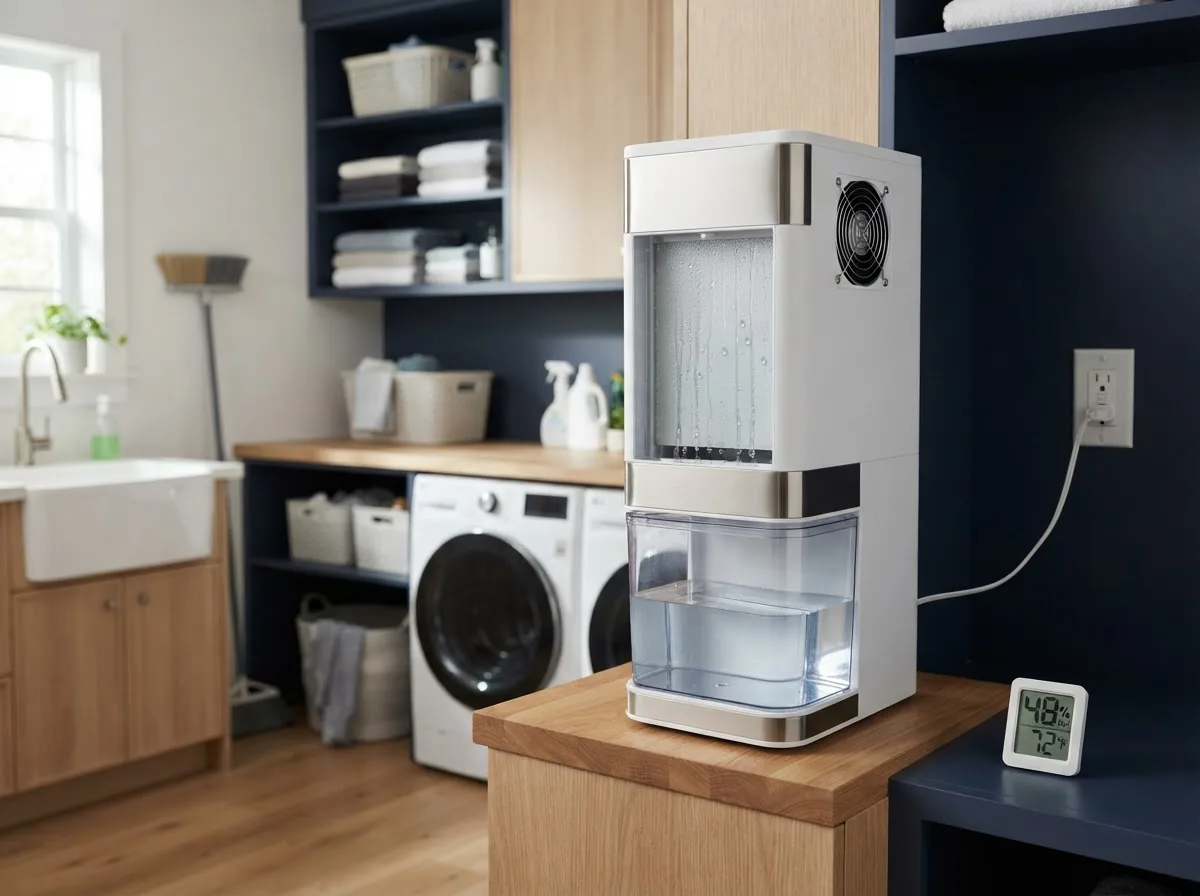
What Is an Atmospheric Water Generator for Home Use?
An atmospheric water generator for home use is a device that extracts moisture from the air around it and collects that moisture as liquid water. Most residential systems rely on refrigeration-style condensation — cooling air below its dew point so water vapor turns into droplets — though other moisture-capture processes exist. Performance depends strongly on environmental conditions and equipment design. Importantly, collected water must be appropriately treated, stored, and maintained according to system instructions and applicable safety guidance.
How Does a Home Atmospheric Water Generator Work?
A home atmospheric water generator (AWG) works by drawing indoor air across a cooled surface or other moisture-capture medium. When air is cooled below its dew point, the water vapor it carries condenses into liquid droplets. Those droplets are collected, optionally filtered or treated, and stored in an internal or external reservoir.
The key stages are:
- Air intake: A fan draws humid air into the system.
- Humidity: The amount of water vapor in the air determines how much water can be captured.
- Dew point: The temperature at which water vapor condenses into liquid. The cooling surface must be below this temperature.
- Cooling / moisture capture: A compressor-based coil or other medium cools the air to trigger condensation.
- Condensation: Water droplets form on the cold surface.
- Collection: Droplets run into a collection tray or tank.
- Filtration: Many systems pass water through filters before storage.
- Treatment: Some systems include UV or other disinfection steps.
- Storage: Collected water is held in a reservoir for use.
For a deeper look at the underlying science — including how to evaluate a DIY atmospheric water generator — see our complete educational guide. For a broader look at the different methods of capturing moisture from air, see our guide on how to make water from air.
Will an Atmospheric Water Generator Work in Your Home?
Whether an atmospheric water generator is practical for your home depends on several everyday conditions that are easy to overlook. Before setting expectations, it helps to understand the factors that shape real-world performance.
- Relative humidity: The higher the humidity, the more water vapor is available to capture. Dry indoor air means less water per hour of operation.
- Temperature: Warm air holds more water vapor than cold air. A warm, humid room is generally more favorable than a cold, dry one.
- Seasonal conditions: Humidity and temperature change throughout the year. Output in a humid summer may differ significantly from output in a dry winter.
- Indoor vs. outdoor air source: Some systems draw from indoor air, while others can be placed in more humid outdoor or semi-outdoor spaces. Indoor air in heated or air-conditioned homes may be drier than outside air.
- Ventilation: Stagnant air around the unit reduces the supply of fresh humid air. Adequate airflow helps the system operate efficiently.
- Equipment placement: Where you place the unit affects its exposure to humid air, temperature, and ventilation.
- Available electrical power: Condensation-based systems use energy to cool air. Your circuit or backup power source must handle the demand safely.
- Household water expectations: If you expect the unit to replace your entire household water supply, you may be disappointed. If you see it as a supplemental source, your expectations are more realistic.
Reality Check
Humidity Is One of the Most Important Factors
Relative humidity (RH) measures how much water vapor is currently in the air compared to the maximum it could hold at that temperature. Higher RH means more water is available for a condensation-based system to capture. Lower RH means the system must process more air to collect the same amount of water, which increases energy use and reduces efficiency.
Temperature interacts with humidity: warm air holds more vapor than cold air, so the same RH reading at a higher temperature means more actual water in the air. Dew point — the temperature at which condensation begins — is another way to think about this. A higher dew point means the cooling surface does not need to be as cold to produce water.
| Condition | Relative Suitability for Condensation-Based AWG |
|---|---|
| Warm + humid | Generally more favorable |
| Warm + dry | More challenging |
| Cool + humid | Performance depends heavily on design |
| Cold + dry | Generally challenging |
These are relative comparisons only. No condition guarantees a specific water output.
TempPro TP50 Digital Hygrometer Indoor Thermometer
A simple hygrometer can help you understand your home's temperature and relative humidity before you estimate whether condensation-based water generation is realistic in your environment.
Check Current Price →Disclosure: This section contains affiliate links. As an Amazon Associate I earn from qualifying purchases.
How Much Water Can a Home Atmospheric Water Generator Produce?
This is one of the most common questions, and the honest answer is that output depends on many interacting variables. There is no universal gallon-per-day figure that applies to every home and every unit.
Water output is influenced by:
- Humidity: More water vapor in the air means more water available to capture.
- Temperature: Warmer air holds more vapor, but cooling it to the dew point requires more energy.
- Airflow: Moving enough humid air across the cooling surface is essential for continuous production.
- System capacity: Larger cooling surfaces and more powerful compressors can process more air.
- System efficiency: How well the system transfers heat and captures condensation determines water per unit of energy.
- Runtime: How many hours per day the system operates directly affects total daily output.
- Maintenance: Dust, biofilm, and mineral buildup reduce efficiency over time.
- Power availability: If the system cannot run — due to an outage or insufficient power — it produces no water.
When evaluating a product, look at the manufacturer's published performance conditions. At what temperature and humidity were the output figures measured? Are those conditions similar to your home environment? If a unit is rated under warm, humid test conditions and your home is cool and dry, expect lower real-world output.
We do not provide guaranteed gallon figures because performance is too variable. The most useful approach is to compare specifications under conditions similar to your own climate and home.
How Much Electricity Does an Atmospheric Water Generator Use?
Condensation-based atmospheric water generators use energy to cool air. The main energy consumers are the compressor (or other cooling mechanism), fans that move air across the cooling surface, pumps that move collected water, and any filtration or treatment components. Runtime and system efficiency also matter — a unit that runs long hours in low-humidity conditions uses more energy per unit of water than one operating efficiently in a humid environment.
Rather than focusing on a single wattage number, the most useful way to think about energy consumption is to compare it against actual collected-water output:
Daily energy use ÷ Daily water output = Energy required per unit of collected water
This ratio helps you compare the operating efficiency of different systems under similar conditions. We do not fabricate universal kWh figures because energy use varies too widely across models, climates, and operating modes. Check manufacturer specifications and, if possible, look for independent testing under realistic conditions.
Jackery Explorer 1000 v2 Portable Power Station
Portable power can be relevant when considering electrically powered water equipment during an outage, but actual compatibility depends on the equipment's continuous wattage, startup demand, runtime, and battery capacity.
Check Current Price →Disclosure: This section contains affiliate links. As an Amazon Associate I earn from qualifying purchases.
Where Should a Home Atmospheric Water Generator Be Installed?
Installation location affects performance, safety, and everyday livability. Consider the following when choosing a spot:
- Airflow: The unit needs access to fresh, humid air. Stagnant or enclosed spaces reduce performance.
- Temperature and humidity: A warm, humid room is generally more favorable than a cold, dry one.
- Drain or collection considerations: Plan where excess water or overflow will go.
- Ventilation: The system releases heat as it cools air. Adequate ventilation prevents the surrounding area from becoming uncomfortably warm.
- Electrical outlet availability: Use a grounded outlet that can handle the system's power requirements safely. Do not use damaged or undersized extension cords.
- Noise: Place the unit where compressor and fan noise will not disturb daily activities or sleep.
- Heat output: Condensation-based systems release heat. Consider how this affects the room, especially in warm climates.
- Maintenance access: Leave enough space to clean collection surfaces, replace filters, and access internal components.
- Sanitary surroundings: Avoid dusty, dirty, or contaminated areas that could introduce airborne contaminants into collected water.
This section provides general guidance only. It does not include electrical wiring instructions. Always consult qualified professionals and manufacturer documentation for any powered equipment.
Are Atmospheric Water Generators Noisy?
Noise is a practical concern for home use. The main sources of sound in a condensation-based system are the compressor, fans, and any internal pumps. The level varies by model, capacity, and operating mode — a system running at full capacity to produce water quickly will typically be louder than one in a lower-output or standby mode.
Rather than comparing to a single decibel figure, it can help to think conceptually about household appliances you already own. A system with a compressor and fan may produce sound comparable to a dehumidifier, portable air conditioner, or refrigerator — but the exact level depends on the specific model. Check manufacturer specifications and, if possible, look for independent noise measurements.
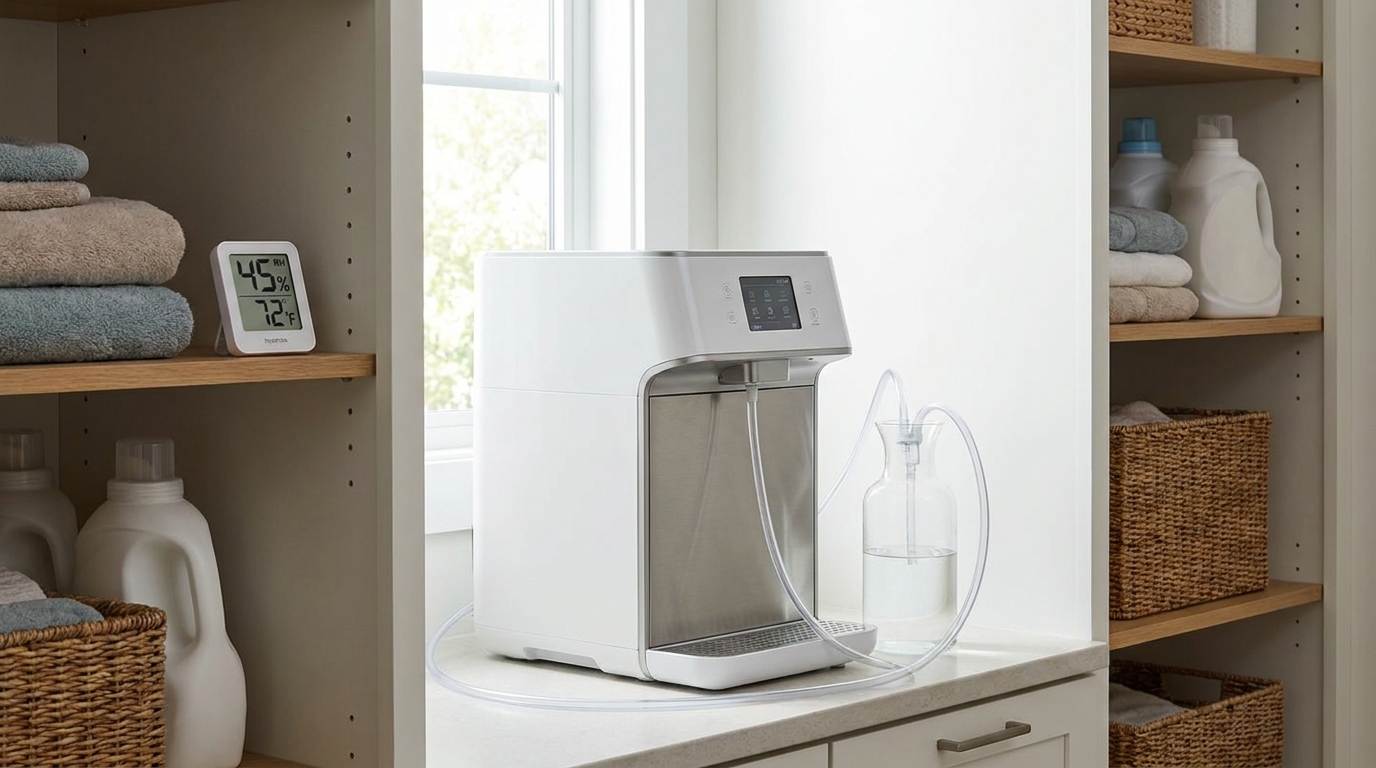
Placement also matters. A unit installed in a garage, utility room, or basement may be less noticeable than one placed in a kitchen or bedroom-adjacent space. Consider your household's noise tolerance when choosing where to install the system.
Is Water From a Home Atmospheric Water Generator Safe to Drink?
This is one of the most important questions to ask. The short answer: collected water should not automatically be treated as potable. Just because water looks clear does not mean it is safe to drink.
Several factors can affect the safety of water collected from air:
- Airborne contaminants: Dust, pollen, pollutants, and particulates in the air can be captured along with water vapor.
- Internal surfaces: Collection trays, coils, and tubing can accumulate dust or biofilm if not cleaned regularly.
- Microbial growth: Warm, moist environments inside the system can harbor bacteria or mold if sanitation is neglected.
- Storage tank cleanliness: Water sitting in an unclean tank can become contaminated over time.
- Filter changes: Filters that are not replaced on schedule lose effectiveness and can themselves become a source of contamination.
- Sanitation: Regular cleaning of internal components is essential for any system producing water for consumption.
- Water testing: The only way to confirm water quality is to test it.
- Manufacturer instructions: Follow the manufacturer's maintenance and treatment guidance.
- Local public-health guidance: Public-health agencies provide water-safety recommendations that apply to your area.
Clear Water Does Not Automatically Mean Safe Water
17-in-1 Complete Drinking Water Test Kit
A consumer water-testing kit can help screen several common water characteristics, but it should not be presented as proof that water is completely safe or as a replacement for professional laboratory testing when laboratory analysis is appropriate.
Check Current Price →Disclosure: This section contains affiliate links. As an Amazon Associate I earn from qualifying purchases.
Storage and Treatment Still Matter
Even with a well-designed atmospheric water generator, how you collect, store, and treat water determines whether it remains safe to use over time. A good system does not eliminate the need for good storage and treatment practices.
- Clean collection: Ensure collection surfaces and trays are cleaned on a regular schedule.
- Food-safe materials: Use containers and tubing made from food-safe materials to avoid leaching.
- Covered storage: Store collected water in sealed containers to prevent contamination from dust, insects, or airborne particles.
- Cleaning and sanitation: Sanitize storage containers on a regular schedule to prevent biofilm and microbial growth.
- Filtration and treatment: If water is intended for drinking, use appropriate filtration or disinfection methods and confirm results with testing.
- Avoiding stagnant water: Do not let collected water sit unused for long periods. Rotate stored water and label containers with collection dates.
WaterStorageCube Collapsible Water Container with Spigot — 2.6 Gal, 2-Pack
Collapsible containers can provide flexible backup-water storage when space is limited and may complement other household water-preparedness strategies.
Check Current Price →Disclosure: This section contains affiliate links. As an Amazon Associate I earn from qualifying purchases.
Aquatabs Water Purification Tablets, 397mg 100 Pack
Water-treatment tablets can be one component of emergency water planning when used according to the product's instructions and when appropriate for the water source being treated.
Check Current Price →Disclosure: This section contains affiliate links. As an Amazon Associate I earn from qualifying purchases. Water-treatment tablets do not remove every possible contaminant and do not make every unknown water source safe. Use according to the product's instructions and when appropriate for the water source being treated.
Free Interactive Water Planner
Before You Buy Equipment, Find Out How Much Backup Water Your Household Actually Needs
Use the free 14-Day Family Water Backup Planner to calculate your household target, see your current gap, and identify which parts of your backup plan need the most attention.
Build My Free Water Plan →Free interactive 14-Day Family Water Backup Planner
- Personalized household water target
- Current water-gap calculation
- Water Readiness Score
- Storage and treatment checklist
- Backup-source planning
- Personalized 14-day action plan
- Printable planner sent by email
How Much Does an Atmospheric Water Generator for Home Use Cost?
Rather than inventing exact market prices, it is more useful to understand the cost categories that make up total cost of ownership. Purchase price is only one part of the picture.
- Equipment purchase: The upfront cost of the unit itself, which varies widely by capacity and features.
- Installation: Some systems may require professional installation or specific placement considerations.
- Electricity: Ongoing energy costs based on how many hours per day the system runs and your local electricity rate.
- Filters: Replacement filters on the manufacturer's recommended schedule.
- Sanitation: Cleaning supplies for regular maintenance of collection surfaces and storage tanks.
- Maintenance: Periodic servicing, part replacement, and inspections.
- Replacement parts: Components that wear out over time, such as pumps, seals, or sensors.
- Water testing: Testing supplies to confirm collected water quality.
- Backup power: If you plan to use the system during outages, factor in the cost of a generator or portable power station.
Total cost of ownership matters more than purchase price alone. A less expensive unit that consumes more electricity or requires frequent filter changes may cost more over time than a more efficient system with a higher upfront price. When comparing options, estimate both the purchase cost and the ongoing operating costs over the expected life of the system.
Coming soon: Atmospheric Water Generator Price Guide
DIY vs Commercial Atmospheric Water Generator for Home Use
If you are considering atmospheric water generation for home use, you may be weighing a DIY build against a commercial unit. Neither option is universally better — the right choice depends on your goals, budget, and technical comfort.
| Factor | DIY | Commercial AWG |
|---|---|---|
| Initial cost structure | Can be lower for small builds; varies widely | Generally higher; priced by capacity and features |
| Installation | You source, assemble, and troubleshoot everything | Typically ready to operate with minimal setup |
| Customization | High — you control every component and layout | Limited to manufacturer configurations |
| Published performance specs | You must measure performance yourself | Manufacturer provides rated specifications |
| Water-treatment integration | You select and install treatment separately | Often includes built-in filtration |
| Maintenance | You handle all cleaning, repairs, and part replacement | Often supported by warranty or service plan |
| Warranty / support | Limited to individual component warranties | Manufacturer warranty and customer support |
| Troubleshooting | You diagnose and fix issues yourself | Manufacturer support may be available |
| Performance predictability | Less predictable; depends on your build | More predictable under rated conditions |
For a detailed educational walkthrough of the DIY approach, see our DIY Atmospheric Water Generator guide.
Can You Run an Atmospheric Water Generator With Solar Power?
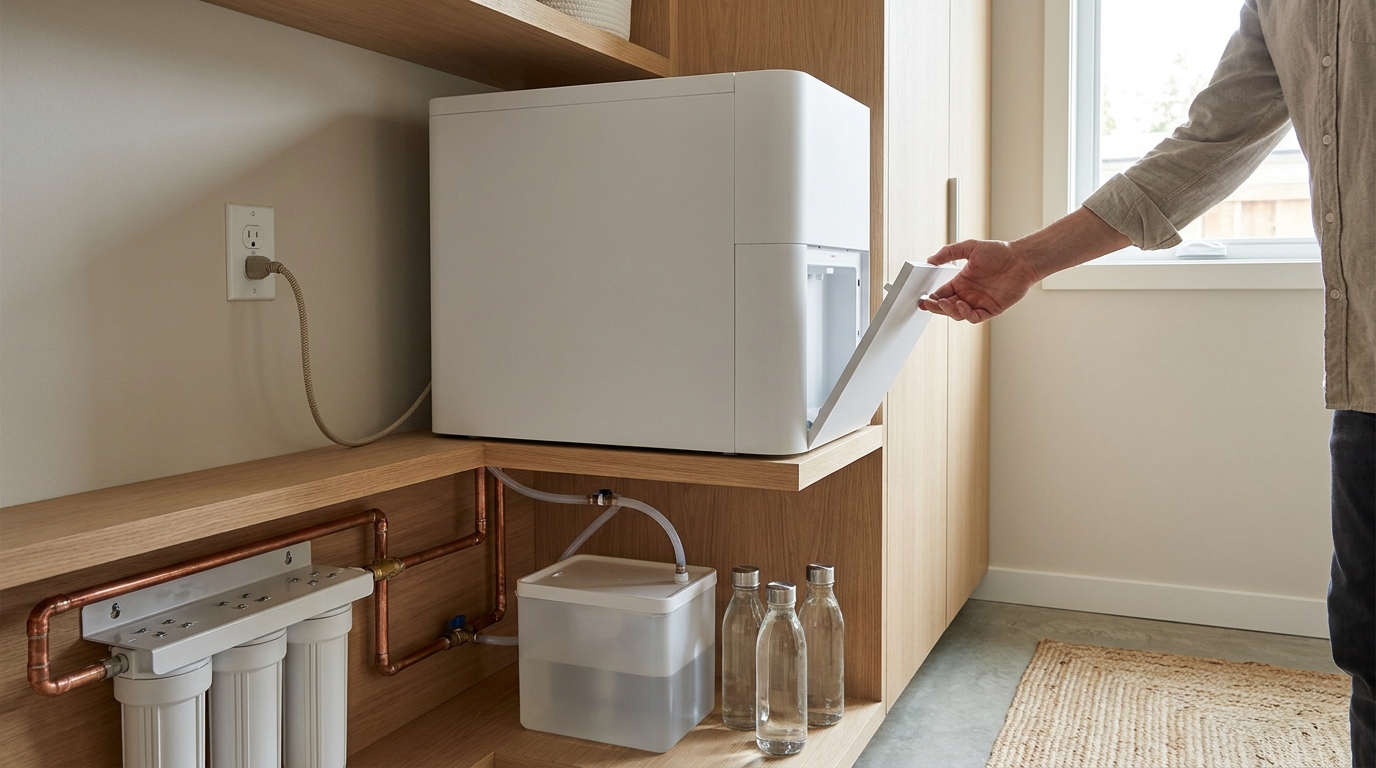
Solar power can run an atmospheric water generator, but the solar system must be properly sized to handle the energy demand. This is not a simple plug-and-play scenario — it requires understanding how much power the AWG needs and how much your solar setup can provide.
- Solar panels: Generate electricity during daylight hours. The panel array must be large enough to power the AWG and charge batteries.
- Battery storage: Essential because humidity often peaks at night or during overcast conditions when solar panels are not producing. Batteries allow the system to run when humidity is highest.
- Inverter: Converts solar DC power to the AC power most home AWGs require. The inverter must handle the system's continuous and startup power draw.
- AWG electrical demand: Condensation-based systems can be energy-intensive. You need to know the system's wattage and expected daily runtime.
- Runtime: How many hours per day the system runs determines total energy needs. More runtime means more solar and battery capacity.
- Weather: Cloudy days reduce solar production. Plan for periods when solar input is lower than average.
- Solar availability: Your geographic location and seasonal sunlight hours affect how much energy you can generate.
- System sizing: The solar array, battery bank, and inverter must all be sized to work together. Undersizing any component limits the system's ability to run consistently.
This section provides general guidance only. It does not include electrical wiring or system design instructions. Always consult qualified professionals for solar system design and installation.
Learn more in our complete guide: Off-Grid Water System.
Is an Atmospheric Water Generator a Good Emergency Water Solution?
An atmospheric water generator can be one potential backup source within a layered emergency water plan — but it should not necessarily replace the other layers. A resilient household plan combines several approaches so that if one falls short, the others still provide value.
Stored Water
A reserve of clean water kept before any disruption. This is your most reliable immediate source.
Treatment Capability
The ability to filter, disinfect, or otherwise make water from any source safer to use.
Alternative Sources
Backup ways to obtain water, which may include atmospheric water generation, rainwater collection, or other options.
Household Plan
A clear plan covering who does what, how resources are managed, and how the plan is practiced before it is needed.
Atmospheric water generation can potentially serve as one alternative source within this layered approach. For more on building a resilient household, see our Preparedness & Healthy Home guides and our guide to building an emergency water supply for home.
DIY Water-From-Air Resource
Want to Explore a More Detailed DIY Water-From-Air Approach?
If you are interested in going beyond the basic concepts in this guide, there is a separate step-by-step DIY water-from-air presentation you can review. It focuses on a DIY approach rather than purchasing a complete commercial atmospheric water generator.
Before deciding whether it fits your household, consider your local humidity, temperature, power availability, materials, maintenance requirements and water-treatment needs.
See the DIY Water-From-Air Guide →
Affiliate disclosure: We may earn a commission if you purchase through links on this page, at no additional cost to you.
Questions to Ask Before Buying a Home Atmospheric Water Generator
Use this checklist to evaluate any system you are considering. If you cannot find clear answers to these questions, that is itself useful information.
- What humidity and temperature range does the manufacturer use for published output?
- How much water is produced under conditions similar to my home?
- How much electricity does it consume?
- How often do filters need replacement?
- How is the system sanitized?
- What testing or certification information is available?
- How noisy is it?
- Where will it be installed?
- What maintenance is required?
- What warranty or support exists?
- How will collected water fit into my broader backup plan?
Who Might Consider a Home Atmospheric Water Generator?
An atmospheric water generator for home use may be worth exploring for several types of households:
- Homeowners researching alternative water sources: If you are curious about reducing dependence on a single municipal supply, an AWG can be one supplemental option to study.
- Humid-climate households: Homes in warm, humid regions are generally more favorable for condensation-based generation.
- Off-grid users: Those with solar or battery systems may be able to power an AWG as part of a broader off-grid water strategy.
- Preparedness-oriented households: Families building a layered backup-water plan may add atmospheric generation as one alternative source.
- People comparing water technologies: If you are evaluating different approaches — stored water, filtration, rainwater, atmospheric generation — an AWG is one option to understand.
None of these scenarios implies that everyone needs an atmospheric water generator. It is one option among many, and its practicality depends on your climate, budget, and goals.
Who May Be Better Served by Other Water Options?
An atmospheric water generator is not the right choice for every household. In some situations, other water options may be simpler, more economical, or more reliable:
- Very dry climates: In arid regions, output is typically much lower and energy use per unit of water is higher. Stored water or other sources may be more practical.
- Households with inexpensive, reliable municipal water: If your tap water is dependable and affordable, a home AWG may not offer meaningful value for everyday use.
- Users with limited power: Condensation-based systems can be energy-intensive. If your power supply is limited or unreliable, the system may not run consistently enough to be useful.
- People expecting zero-maintenance water production: All AWGs require regular cleaning, filter changes, and sanitation. If you want a completely hands-off solution, this may not be the right fit.
- Situations where storage and filtration are simpler and more economical: For many households, keeping stored water and a good filtration system is more cost-effective than investing in and operating an AWG.
Being honest about when an atmospheric water generator may not be the best fit is part of providing trustworthy information. The goal is to help you make an informed decision — not to promote a single solution for every situation.
Frequently Asked Questions
What is the best atmospheric water generator for home use?
There is no single best unit for every household. The right choice depends on your local humidity, temperature, power availability, budget, noise tolerance, and how the collected water fits into your broader backup plan. Compare manufacturer specifications under conditions similar to your own climate rather than relying on peak-output claims.
Do atmospheric water generators really work?
Yes, atmospheric water generators do extract moisture from air and collect it as liquid water. However, how much water they produce depends heavily on humidity, temperature, airflow, system capacity, and runtime. A unit that performs well in warm, humid test conditions may produce substantially less water in a cooler or drier home environment.
How much water can an atmospheric water generator make per day?
Output varies based on relative humidity, temperature, airflow, system capacity, efficiency, runtime, maintenance, and power availability. We do not provide universal gallon figures because performance is too variable. Check the manufacturer's published performance conditions and compare them to your actual home climate before setting expectations.
Do atmospheric water generators work in dry climates?
They can work in dry climates, but output is typically much lower because dry air holds less water vapor. The system must process more air to capture the same amount of water, which increases energy use and reduces efficiency. Passive methods are especially limited in arid environments.
How much electricity does an atmospheric water generator use?
Energy consumption depends on the compressor, fans, pumps, filtration, runtime, and system efficiency. Cooling-based condensation systems can be energy-intensive. The most useful comparison is energy consumed per unit of water actually collected under your real-world conditions, not under ideal test conditions.
Are atmospheric water generators expensive to run?
Operating cost depends on your local electricity rate, how many hours per day the system runs, and how much water it produces. A system that runs long hours in low-humidity conditions may cost more per unit of water than one operating efficiently in a humid climate. Factor in filter replacements, sanitation supplies, and maintenance as well.
Is atmospheric water safe to drink?
Not automatically. Collected water can pick up airborne contaminants, and collection surfaces or storage tanks can harbor microbial growth if not maintained. If water is intended for drinking, use food-safe materials, appropriate treatment and disinfection, and water-quality testing. Follow manufacturer instructions and applicable public-health guidance. Clear-looking water is not necessarily safe water.
Can an atmospheric water generator run on solar power?
Solar power can run an atmospheric water generator, but the solar system must be sized to handle the energy demand of cooling and airflow components. Battery storage is typically needed because humidity often peaks when sunlight does not. System sizing depends on the AWG's wattage, runtime, and local solar availability.
Where should an atmospheric water generator be installed?
Install it in a location with adequate airflow, appropriate temperature and humidity, access to an electrical outlet, drainage or collection considerations, ventilation, and room for maintenance access. Avoid enclosed, dusty, or unsanitary surroundings. Consider noise and heat output when choosing a placement spot.
Are atmospheric water generators noisy?
Noise may come from compressors, fans, and pumps. The level varies by model and operating mode. Check manufacturer specifications and, if possible, compare noise levels to household appliances you already own. Placement also affects how noticeable the sound is in living areas.
What maintenance does an atmospheric water generator need?
Typical maintenance includes cleaning collection surfaces and storage tanks, replacing filters on schedule, sanitizing internal components, checking for microbial growth, and testing collected water quality. Follow the manufacturer's maintenance schedule and use food-safe cleaning practices.
Is a dehumidifier the same as an atmospheric water generator?
No. Both remove moisture from air, but a dehumidifier is designed to reduce indoor humidity and its collected water is generally not intended for consumption. An atmospheric water generator is designed with collection, filtration, and storage aimed at producing water for use, though any collected water still requires appropriate treatment before drinking.
Can a home atmospheric water generator replace stored emergency water?
It can serve as one supplemental source within a layered plan, but it should not necessarily replace stored water, treatment capability, or a household response plan. Output depends on environmental and equipment conditions, so relying on a single source leaves you more exposed than combining several approaches.
Is DIY or commercial better for home use?
Neither is universally better. A DIY build offers customization and potentially lower cost for small experiments, but requires you to source, assemble, troubleshoot, and measure performance yourself. A commercial unit offers published specifications, built-in filtration, warranty support, and more predictable performance, but at a higher purchase price.
How do I know whether an AWG will work in my climate?
Measure your home's relative humidity and temperature over several days using a hygrometer, then compare those readings to the manufacturer's published performance conditions. If your home is warm and humid, condensation-based generation is generally more favorable. If your home is cool or dry, expect lower output and higher energy use per unit of water.
Related Guides
DIY Atmospheric Water Generator
Full step-by-step educational guide.
Read moreHow to Make Water From Air
Methods for capturing water from air.
Read moreOff-Grid Water System
Water independence beyond the grid.
Read moreEmergency Water Supply for Home
Building a household backup plan.
Read morePreparedness & Healthy Home
Practical guides for a resilient household.
Read moreStart With Your Household Water Target
Before comparing equipment, know what your household actually needs. Use the free planner to calculate your 14-day target and identify your current backup-water gap.
Start My Free Water Plan →