OFF-GRID WATER GUIDE
Off-Grid Water System: How to Build a Practical Water Plan for a Home or Cabin
Learn how off-grid water systems combine water sources, storage, pumping, treatment, power, and backup options into a practical household system.
Independent educational guide • Site conditions matter • Water safety matters
What Is an Off-Grid Water System?
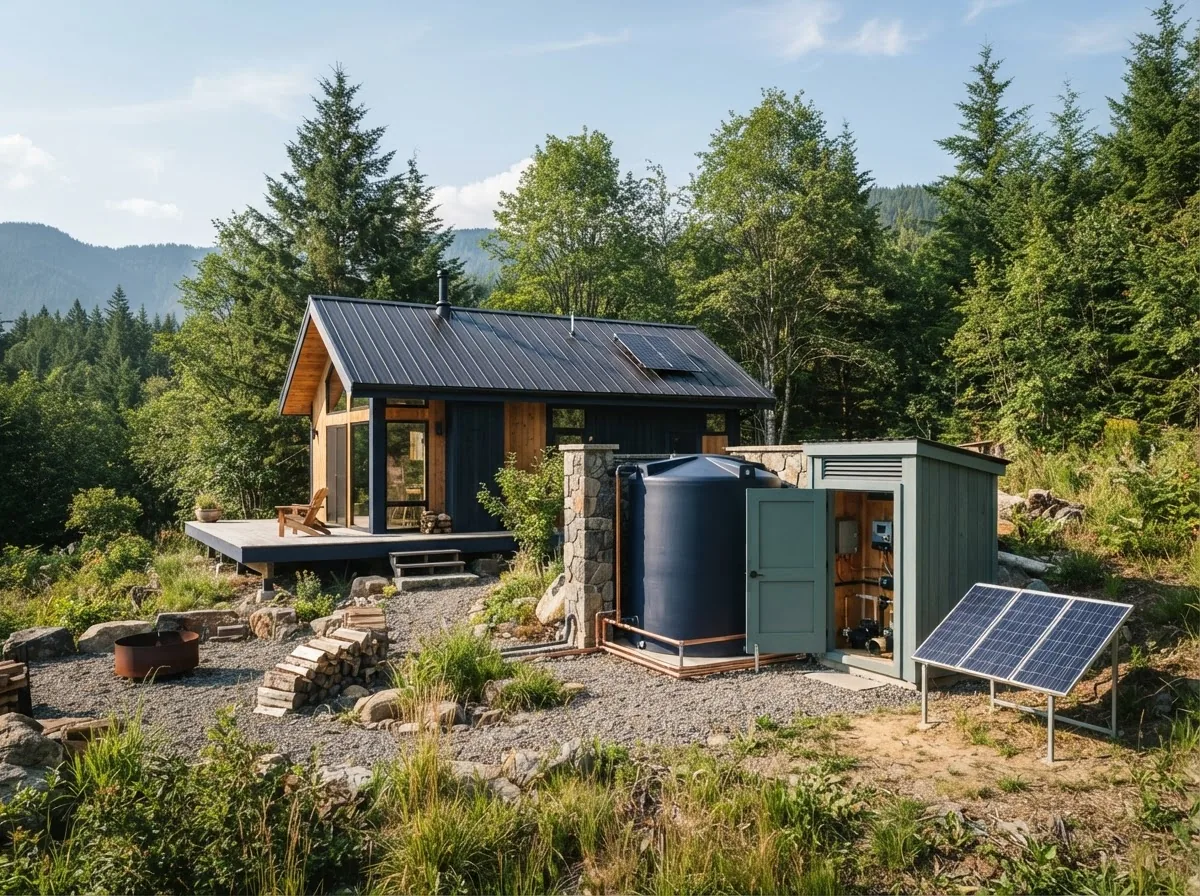
An off-grid water system provides, stores, treats, and distributes water without relying entirely on a municipal water utility. A complete system generally needs a source, storage, treatment, distribution, power where required, and backup options. System design depends on property conditions, climate, water quality, local requirements, and household demand. There is no one-size-fits-all configuration — each system is tailored to the site and the people who depend on it.
The Five Parts of an Off-Grid Water System
Every off-grid water system, no matter how simple or complex, is built from the same five functional parts. Understanding these layers helps you think through your own system systematically rather than jumping straight to equipment.
Water Source
Storage
Treatment
Pump / Distribution
Backup
Water Source
Where your water comes from — a well, spring, rainwater catchment, delivered water, surface water, or atmospheric water generation. The source determines everything else about your system design.
Storage
Where collected water is held until it is needed. Storage bridges the gap between when water is available and when it is used, and it provides a buffer during source interruptions.
Treatment
Filtration, disinfection, and testing that make water safer for its intended use. Treatment requirements depend on the source, water quality, and whether the water will be consumed.
Pump / Distribution
How water moves from storage to where it is used — through gravity, pumps, pressure tanks, and plumbing lines. Distribution must deliver adequate flow and pressure for household needs.
Backup
Redundancy for when any part of the system fails — backup power, a secondary water source, portable treatment, and stored reserves. Backup is what keeps a single failure from becoming a household emergency.
Step 1: Know How Much Water Your Household Needs
System design starts with demand. Before you choose a source, size a tank, or select a pump, you need a realistic estimate of how much water your household uses. This number drives every other decision in the system.
Consider the following factors:
- Number of people: More people means more water for drinking, cooking, washing, and sanitation.
- Drinking and cooking: Direct consumption needs, which are relatively small but critical.
- Washing and sanitation: Handwashing, dishes, laundry, and toilet flushing typically account for the largest share of household water use.
- Pets: Animals need water daily; include them in your calculation.
- Season: Water use may increase in summer (gardening, cooling) and decrease in winter.
- Guests: Occasional visitors can temporarily increase demand.
- Garden or outdoor use: If you plan to irrigate, factor in seasonal outdoor demand.
Do not rely on a single universal gallon figure. Every household is different. A realistic demand estimate is the foundation of a system that actually works for your situation.
Free Interactive Tool
Start With Your Household Water Target
Use the free 14-Day Family Water Backup Planner to estimate your household target, compare it with what you currently have, and identify your biggest backup-water gaps.
Build My Free Water Plan →Free interactive 14-Day Family Water Backup Planner
- Personalized household water target
- Current water-gap calculation
- Water Readiness Score
- Storage and treatment checklist
- Backup-source planning
- Personalized 14-day action plan
- Printable planner sent by email
Step 2: Choose Your Primary Water Source
Your primary water source is the backbone of the system. The right choice depends on what is available on your property, your climate, your budget, and local regulations. Each source has advantages and limitations.
| Source | Advantages | Limitations |
|---|---|---|
| Well | Reliable if the aquifer is productive; can provide high volumes; independent of rainfall. | Requires drilling, a pump, power, testing, and maintenance; depends on groundwater depth and yield. |
| Spring | Can provide naturally filtered water; low operating cost if flow is reliable. | Seasonal flow variation; requires testing and protection from contamination; not available everywhere. |
| Rainwater | Uses existing roof area; no drilling needed; can supplement other sources. | Depends on rainfall; requires storage and treatment; regulated in some areas. |
| Delivered Water | Simple; no infrastructure needed; useful for intermittent or seasonal use. | Ongoing cost; depends on delivery availability; requires on-site storage. |
| Surface Water | Available where streams or ponds exist; can provide large volumes. | Highly variable; often requires significant treatment; subject to water rights and regulations. |
| Atmospheric Water Generation | Extracts water from air; can work where other sources are unavailable; no drilling. | Output depends heavily on humidity and temperature; requires power; limited volume compared to a well. |
Do not assume every source is legal or automatically potable. Local requirements, water rights, and water-quality regulations vary significantly. Always verify what is permitted in your area and test water before consumption.
For a deep look at atmospheric moisture as a source, see our guides on how to make water from air and atmospheric water generator for home use.
Wells for Off-Grid Homes
A well is one of the most common and reliable off-grid water sources — but only if groundwater is accessible on your property. Wells require significant upfront investment and ongoing maintenance, but a productive well can provide high volumes of water for decades.
- Site suitability: Groundwater depth, geology, and aquifer productivity vary by location. A professional assessment can help determine whether a well is viable.
- Drilling: Well drilling requires specialized equipment and expertise. This is not a DIY project — use a licensed well driller.
- Pump requirements: The pump must be sized for the well depth, desired flow rate, and lift height. Submersible pumps are common for deeper wells.
- Power: Well pumps require electricity. Off-grid systems often use solar-powered pumps with battery backup.
- Water testing: Well water should be tested regularly for bacteria, nitrates, and other contaminants common in your area. See EPA guidance for private well owners for testing recommendations.
- Maintenance: Pumps, pressure tanks, and well casings require periodic inspection and servicing.
- Well yield: The well's recovery rate — how quickly it refills — determines how much water you can draw sustainably.
- Seasonal considerations: Drought can lower the water table. Understand how your well may be affected by seasonal changes.
This section provides general information only. It does not include drilling instructions or professional recommendations. Always consult licensed well drillers and local health authorities.
Rainwater Collection
Rainwater collection uses your roof as a catchment surface, channeling rainfall through gutters into storage. It is a practical option in areas with consistent rainfall and does not require drilling — but it is not automatically potable and is regulated in some locations.
- Roof collection: The roof material and condition affect water quality. Some roofing materials are more suitable for rainwater collection than others.
- Gutters: Properly sized gutters and downspouts channel water efficiently to storage.
- First-flush concepts: A first-flush diverter routes the initial runoff — which carries the most debris — away from storage, improving water quality.
- Storage: Rainwater requires storage to bridge dry periods. Storage size depends on rainfall frequency and household demand.
- Treatment: Roof-collected rainwater should not be assumed potable. It can pick up contaminants from roof surfaces, gutters, and airborne particles.
- Seasonality: Rainfall is intermittent. Your system must store enough to bridge dry spells.
- Local regulations: Rainwater collection is restricted or regulated in some areas. Check local requirements before building a system.
Can You Use Water From Air Off Grid?
Atmospheric water generation can be one possible alternative source within an off-grid water system — but it is not a complete system on its own. An AWG extracts moisture from air and condenses it into liquid water, but output depends heavily on environmental conditions and power availability.
- Humidity: Higher relative humidity means more water available to capture. Dry climates produce far less.
- Temperature: Warm, humid conditions are most favorable. Cold or dry conditions are challenging.
- Power demand: Condensation-based AWGs require significant energy for cooling and airflow. Off-grid use requires solar or battery power sized for the load.
- Solar/battery possibilities: Solar panels with battery storage can power an AWG, but the system must be sized for the AWG's continuous and startup power draw.
- Maintenance: Collection surfaces, filters, and storage tanks need regular cleaning and sanitation.
- Output variability: Production changes with seasons, weather, and time of day. Do not expect constant output.
For a detailed educational walkthrough of the DIY approach, see our DIY atmospheric water generator guide.
Step 3: Size Your Water Storage
Storage is the buffer between when water is available and when it is used. Sizing storage correctly is one of the most important decisions in an off-grid water system. Too little storage and you run short during dry spells or source interruptions. Too much and you add unnecessary cost and complexity.
- Daily demand: Start with your household's estimated daily water use.
- Days of reserve: How many days of water do you want stored? More days means more security but larger tanks.
- Source reliability: A reliable well may need less storage than a rainwater-only system. Less reliable sources require more storage.
- Refill frequency: How often can your source refill the tank? If refills are infrequent, you need more storage.
- Space: Larger tanks require more physical space. Consider where the tank will sit.
- Temperature: In cold climates, freezing is a major concern. Storage must be protected or buried.
- Freeze protection: Above-ground tanks need insulation or heating. Below-ground tanks benefit from stable soil temperatures.
- Container material: Use food-grade materials for potable water. Not all tanks are rated for drinking water.
- Cleaning: Tanks need periodic cleaning and sanitation. Design for access.
- Access: Ensure you can inspect, fill, and maintain the tank.
There is no universal tank size. A weekend cabin may need only a few hundred gallons, while a full-time household may need thousands. Calculate based on your specific demand and source reliability.
WaterStorageCube Collapsible Water Container with Spigot — 2.6 Gal, 2-Pack
A collapsible water container can provide additional short-term water storage alongside a larger off-grid water system when space and portability matter.
Check Current Price →Disclosure: This section contains affiliate links. As an Amazon Associate I earn from qualifying purchases.
Water Tanks: Above Ground vs Below Ground
One of the key storage decisions is whether to place your tank above ground or bury it below. Each approach has trade-offs that affect cost, maintenance, freeze protection, and space.
| Factor | Above Ground | Below Ground |
|---|---|---|
| Installation complexity | Simpler; visible and accessible | More complex; requires excavation |
| Access | Easy to inspect, clean, and repair | Harder to access; may require special equipment |
| Temperature exposure | Exposed to ambient air; may need insulation | More stable ground temperature; less freeze risk |
| Freezing | Vulnerable in cold climates unless protected | Better protected from freezing |
| Inspection | Straightforward visual inspection | Limited visual access |
| Maintenance | Easier to clean and service | More difficult and costly to service |
| Space | Uses visible yard or structure space | Underground; does not occupy surface space |
| Cost structure | Generally lower installation cost | Higher installation cost; potentially longer life |
The right choice depends on your climate, site, budget, and maintenance preferences. In cold climates, below-ground tanks offer natural freeze protection. In warmer areas, above-ground tanks may be simpler and more cost-effective.
Step 4: Move Water Through the System
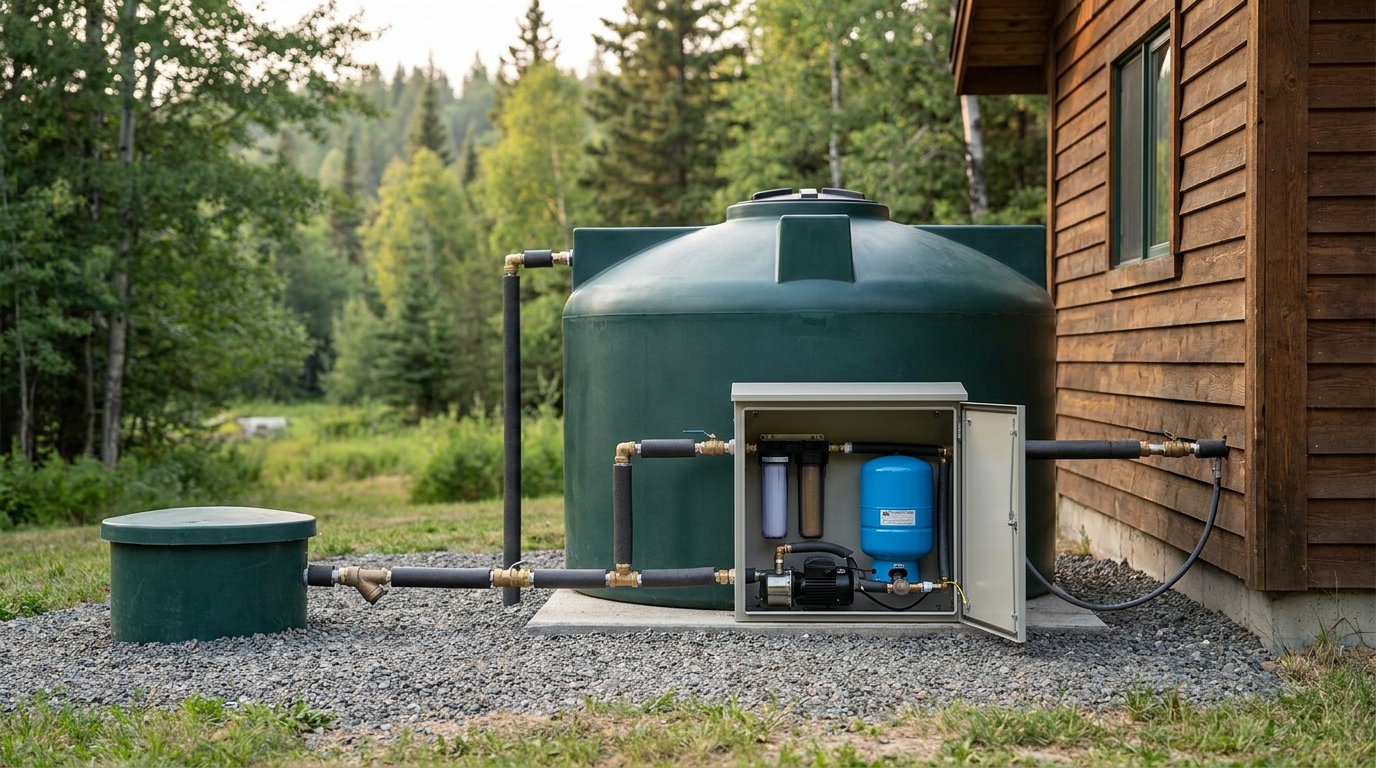
Once water is collected and stored, it needs to reach the point of use. Distribution is how water moves from storage to faucets, showers, and appliances. There are two fundamental approaches: gravity and pumping.
- Gravity: If storage is elevated above the point of use, gravity provides pressure without any pump. Simple, reliable, and works during power outages — but pressure depends on elevation.
- Pumps: When gravity is not available or pressure is too low, a pump moves water through the system. Pumps require power and maintenance.
- Pressure tanks: A pressure tank stores pressurized water so the pump does not run every time a faucet opens. This extends pump life and provides consistent pressure.
- Distribution lines: Plumbing carries water from storage to points of use. Pipe sizing affects flow rate and pressure.
- Elevation: The height difference between storage and the point of use determines gravity pressure. Every foot of elevation adds pressure.
- Flow and pressure: Household fixtures need adequate flow and pressure. Undersized pipes or insufficient elevation can result in weak flow.
This section provides general guidance only. It does not include electrical wiring or plumbing instructions. Always consult qualified professionals for system design. Do not use drainage or sump pumps as potable-water distribution pumps — they are not designed for drinking water.
Gravity-Fed vs Pumped Water Systems
The choice between gravity and pumped distribution affects energy use, reliability, complexity, and cost. Here is a neutral comparison:
| Factor | Gravity-Fed | Pumped |
|---|---|---|
| Energy dependence | No power needed if elevation is sufficient | Requires electricity or manual power |
| Pressure | Depends on elevation; may be low | Consistent, adjustable pressure |
| Complexity | Simple plumbing; few moving parts | More components; pump, pressure tank, controls |
| Elevation requirements | Needs tank above the point of use | Works regardless of elevation |
| Maintenance | Minimal; mostly pipes and valves | Pump servicing, pressure tank, electrical connections |
| Backup capability | Works during power outages | Needs backup power to operate during outages |
Some systems combine both: a pump fills an elevated tank, and gravity handles distribution. This approach provides pump-free pressure during power outages while still allowing water to be lifted to storage.
Step 5: Treat and Filter the Water
Treatment is what makes water safe for its intended use. The right treatment depends on the source, the water quality, and whether the water will be consumed. No single filter handles every contaminant — treatment should be matched to what your water actually contains.
Treatment depends on:
- Source: Well water, rainwater, and surface water each have different contamination profiles.
- Sediment: Particulates that can clog filters and affect taste. Sediment removal is usually the first step.
- Microorganisms: Bacteria, viruses, and parasites that can cause illness. Disinfection is essential for biological safety.
- Chemical contaminants: Minerals, metals, or chemicals that may be present in groundwater or surface water. Specialized treatment may be needed.
- Intended use: Water for drinking requires more treatment than water for flushing toilets or irrigation.
A typical treatment approach includes multiple layers:
- Sediment removal: Filters or settling tanks that remove particulates.
- Filtration: Carbon, ceramic, or other filters that reduce contaminants.
- Disinfection: UV light, chlorination, or other methods that kill or inactivate microorganisms.
- Specialized treatment: Reverse osmosis, water softening, or other methods for specific contaminants where appropriate.
- Testing: The only way to know whether treatment is working is to test the water.
Do not assume that one filter handles every contaminant. Test your water to determine what treatment is actually needed, and follow manufacturer instructions and EPA drinking-water disinfection guidance.
Aquatabs Water Purification Tablets, 397mg 100 Pack
Water-treatment tablets can be one component of backup-water planning when used according to their directions and when appropriate for the source being treated.
Check Current Price →Disclosure: This section contains affiliate links. As an Amazon Associate I earn from qualifying purchases. Water-treatment tablets do not remove every chemical contaminant and should be used according to their directions.
Emergency Filtration as a Backup Layer
Even with a well-designed primary treatment system, portable filtration can serve as a valuable backup layer. It is not necessarily a replacement for a household treatment system, but it provides redundancy when the primary system is unavailable.
Portable filtration may be useful as:
- Secondary backup: A fallback if your primary filtration fails or needs maintenance.
- Travel or emergency equipment: Compact filtration you can take on the road or use in an unexpected situation.
- System failure backup: A way to treat water from an alternative source if your main system is down.
Portable filters are not a primary household solution. They are a complement to — not a replacement for — a properly designed treatment system sized for your household. For short-term household emergency planning specifically, see our emergency water supply for home guide.
5 High-Capacity Emergency Water Straws
Portable filtration straws can provide an additional emergency filtration option when a primary household system is unavailable.
Check Current Price →Disclosure: This section contains affiliate links. As an Amazon Associate I earn from qualifying purchases. Portable filtration straws do not treat every contaminant and should not be relied on as a sole household water treatment solution.
Step 6: Power an Off-Grid Water System
Many off-grid water systems require electricity — for pumps, treatment equipment, controls, and any atmospheric water generation. Power is often the most complex and costly part of an off-grid water system, and it must be designed around the actual energy requirements of your specific equipment.
- Grid-independent power: Solar panels, wind turbines, or micro-hydro can generate electricity without a grid connection.
- Solar: The most common off-grid power source. Panels generate electricity during daylight hours.
- Battery storage: Batteries store energy for use when the sun is not shining. Capacity must match your daily energy needs.
- Generator backup: A fuel-powered generator can recharge batteries or run equipment during extended cloudy periods.
- Pump loads: Well pumps and pressure pumps have specific wattage and startup requirements. Power systems must handle these loads.
- Treatment equipment: UV sterilizers, pumps, and controls all draw power. Add up all loads to size the system.
- Controls: Charge controllers, inverters, and pressure switches manage the system automatically.
Power requirements must be calculated from actual equipment specifications. Do not guess — add up the wattage and runtime of every device the system must support, then size solar, batteries, and inverters accordingly.
Jackery Explorer 1000 v2 Portable Power Station
Portable battery power can support some off-grid equipment during outages, but compatibility depends on actual operating wattage, startup demand, runtime, and battery capacity.
Check Current Price →Disclosure: This section contains affiliate links. As an Amazon Associate I earn from qualifying purchases. Portable power stations have specific capacity and output limits. Verify compatibility with your equipment's wattage and startup requirements before use.
Using Solar Power for Water Equipment
Solar is the most popular off-grid power source for water systems. A solar setup typically includes panels, a charge controller, batteries, and an inverter (if your equipment requires AC power). The system must be sized to handle both the continuous load and the startup surge of pumps and other equipment.
- Solar panels: Generate electricity from sunlight. Panel output depends on size, efficiency, and sun exposure.
- Battery: Stores energy for use at night or during cloudy weather. Capacity must cover your daily energy needs plus a buffer.
- Charge controller: Regulates the flow of electricity from panels to batteries, preventing overcharging.
- Inverter: Converts DC battery power to AC power if your equipment requires it. The inverter must handle continuous and surge loads.
- Equipment demand: Total wattage of all water equipment — pumps, treatment devices, controls — determines system size.
- Sun exposure: Your geographic location and seasonal sunlight hours affect how much energy you can generate.
- System sizing: Panels, batteries, and inverter must all be sized to work together. Undersizing any component limits the system.
This section provides general guidance only. It does not include electrical wiring or system design instructions. Always consult qualified professionals for solar system design and installation.
10AWG 30FT Solar Panel Extension Cable
A solar extension cable can be useful in some portable or off-grid solar layouts when its connector type, wire specification, voltage, current rating, and equipment compatibility are appropriate.
Check Current Price →Disclosure: This section contains affiliate links. As an Amazon Associate I earn from qualifying purchases. Before use, verify connector type, system voltage, current rating, and equipment compatibility. This cable is not universally compatible with all solar setups.
How Much Does an Off-Grid Water System Cost?
There is no single price for an off-grid water system. Cost varies dramatically depending on the source, storage size, pumping method, treatment complexity, power system, and whether you hire professionals or do some of the work yourself. A simple cabin setup with portable storage and a hand pump costs a fraction of a full-time household system with a drilled well, solar pumping, and multi-stage treatment.
Budget by category rather than expecting a universal total:
- Water source development (drilling, catchment, collection)
- Storage tanks or cisterns
- Pumps and pressure systems
- Filtration and treatment equipment
- Solar panels, batteries, and charge controllers
- Plumbing and distribution lines
- Installation labor (professional or DIY)
- Water-quality testing supplies
- Ongoing maintenance and replacement parts
A simple cabin setup and a whole-house system can differ by an order of magnitude in cost. The most useful exercise is to list the components you need for your specific situation and price them individually, including ongoing operating costs like electricity, filter replacements, and maintenance.
Off-Grid Water System for a Tiny Home
Tiny homes present unique water challenges because of their limited space. Every component — tank, pump, filter, plumbing — must fit into a compact footprint while still meeting household needs.
- Limited space: Smaller tanks and compact equipment are necessary. Creative placement is often required.
- Smaller tanks: Storage is constrained by available space, which means more frequent refills or a more reliable source.
- Portable storage: Collapsible containers and portable tanks can supplement fixed storage.
- Water conservation: Reducing demand through low-flow fixtures and mindful use is especially important in a tiny home.
- Pump and treatment footprint: Compact pumps and inline filters save space while still providing basic treatment.
- Freeze protection: Tiny homes on wheels may be moved to different climates. Plan for freeze protection in any climate the home may encounter.
Off-Grid Water System for a Cabin
A cabin used seasonally or on weekends has different requirements than a full-time home. The system must handle long periods of disuse and seasonal weather extremes.
- Seasonal occupancy: The system may sit unused for months. Winterization is essential in cold climates.
- Winterization: Pipes, pumps, and tanks must be drained or protected from freezing before the cold season.
- Source reliability: Springs and surface water may freeze or dry up seasonally. Understand how your source changes through the year.
- Long periods unused: Stagnant water in tanks and pipes can develop microbial growth. Flush the system before use after a long absence.
- Maintenance: Schedule inspections at the start and end of each season of use.
- Freeze exposure: Even a mild winter can damage unprotected plumbing. Insulate or drain everything that could freeze.
Off-Grid Water System for a Full-Time Home
A full-time off-grid household has the highest reliability requirements. The system must provide consistent water every day, year-round, with enough redundancy to handle failures without interrupting daily life.
- Higher reliability requirements: Daily use means the system must work consistently, not just on weekends or holidays.
- Larger storage: More people and daily use require more storage to bridge source interruptions.
- Redundancy: A backup pump, secondary water source, and backup power are important for a full-time household.
- Maintenance: Regular maintenance schedules are essential. A failure in a full-time system affects daily life immediately.
- Treatment: Full-time consumption requires reliable, properly maintained treatment. Testing should be regular.
- Household demand: Daily demand is higher and more consistent than a seasonal property. Size the system accordingly.
- Backup power: A generator or larger battery bank ensures water access during extended power system issues.
What Happens When One Part of the System Fails?
Redundancy is the most important principle in off-grid water system design. A system that depends on a single component — one pump, one power source, one filter — is vulnerable to a single point of failure. When that component fails, the entire household loses water.
Common failure scenarios include:
- Primary water source unavailable: A well runs dry, a spring freezes, or rainwater storage empties during a drought. A backup source provides water when the primary fails.
- Pump failure: Pumps are mechanical devices that wear out. A backup pump or manual pump keeps water flowing.
- Power loss: Solar panels fail, batteries degrade, or a generator runs out of fuel. Backup power or a gravity-fed line keeps water moving.
- Filter issue: A filter clogs, reaches end of life, or is bypassed. A spare filter or secondary treatment method maintains water safety.
- Frozen line: A pipe or fitting freezes and bursts. Insulation, heat tape, or a gravity bypass prevents a total outage.
- Tank contamination: Debris, animals, or microbial growth contaminate storage. A secondary tank or portable treatment provides a clean alternative.
The goal is not to prevent every failure — that is impossible. The goal is to ensure that when one part fails, the rest of the system still provides water. Multiple layers are more resilient than one perfect component.
A Simple Off-Grid Water System Planning Example
Here is a conceptual example only — not a universal recommendation. Every property is different, and your system should be designed for your specific conditions, demand, and local requirements.
Primary Source (Well or Rainwater)
Storage Tank
Sediment Treatment
Filtration / Treatment
Pump / Pressure
Household
Backup layers:
- Portable stored water (collapsible containers kept in reserve)
- Portable treatment (filtration straws or treatment tablets)
- Backup power (portable power station or generator)
This is a conceptual framework, not engineering advice. Do not treat these sizes as universal recommendations. Consult qualified professionals for system design specific to your property.
Alternative Water Source
Interested in Adding Water-From-Air to an Off-Grid Plan?
Atmospheric moisture collection is one possible alternative source some households may want to investigate. If you are interested in a DIY water-from-air approach, there is a separate presentation you can review.
Consider local humidity, temperature, energy use, maintenance, water treatment, and realistic household demand before deciding whether it fits your situation.
Explore the DIY Water-From-Air Approach →
Affiliate disclosure: We may earn a commission if you purchase through links on this page, at no additional cost to you.
Frequently Asked Questions
How do you get water when living off grid?
Off-grid water typically comes from a well, rainwater collection, a spring, delivered water, surface water, or atmospheric water generation. Each source requires its own collection, storage, treatment, and distribution setup. Most off-grid households combine a primary source with backup options rather than relying on a single source.
What is the best water source for an off-grid home?
There is no single best source — it depends on your property. A productive well is often the most reliable if groundwater is accessible. Rainwater works well in areas with consistent rainfall. Atmospheric water generation can supplement other sources in humid climates. The best source is the one that matches your site conditions, climate, budget, and water-quality requirements.
How much water storage does an off-grid home need?
Storage depends on household size, daily demand, source reliability, and how long you want to bridge interruptions. A seasonal cabin used on weekends needs far less storage than a full-time household. Calculate your daily demand, consider how often your source can refill, and size storage to cover the longest realistic gap.
How much does an off-grid water system cost?
Cost varies dramatically based on the source, storage size, pumping method, treatment complexity, and power system. A simple rainwater setup with portable storage can be relatively inexpensive, while a drilled well with solar pumping and full treatment can cost significantly more. Budget by category rather than expecting a single universal price.
Can a well run off solar power?
Yes, a well pump can run on solar power, but the solar array, battery bank, and pump must be properly sized for the pump's wattage, startup demand, and daily runtime. Solar well pumping is common in off-grid systems but requires careful calculation of energy needs and sun availability.
Can rainwater supply an off-grid home?
Rainwater can supply an off-grid home in areas with sufficient rainfall, but it requires adequate storage to bridge dry periods, proper collection surfaces, and treatment before consumption. Rainwater collection is also regulated in some areas, so check local requirements before investing in a system.
Can atmospheric water generation work off grid?
Atmospheric water generation can work off grid if you have sufficient power — typically from solar and batteries — and adequate humidity. However, output depends heavily on environmental conditions and is usually a supplemental source rather than a primary household supply.
Do off-grid water systems need electricity?
Not all off-grid water systems need electricity. Gravity-fed systems can deliver water without power if the storage tank is elevated above the point of use. However, most systems that use pumps, treatment equipment, or atmospheric water generation require some form of electrical power.
Can an off-grid water system use gravity?
Yes. If your storage tank is positioned above the point of use — on a hill, a tower, or an upper floor — gravity can provide water pressure without any pump. Gravity-fed systems are simple, reliable, and work during power outages, but pressure depends on elevation and may be lower than a pumped system.
What type of pump is used in an off-grid water system?
Common off-grid pump types include submersible well pumps, surface pumps, and hand pumps for backup. The right pump depends on the water source, depth, required flow rate, and available power. Always choose a pump designed for your specific application and water source.
How should off-grid water be filtered?
Filtration depends on the source and intended use. A typical approach includes sediment removal, filtration for particulates, and disinfection for microorganisms. Some sources may need additional treatment for specific contaminants. Water should be tested to determine what filtration is actually needed — no single filter handles every contaminant.
How do you prevent water tanks from freezing?
Freeze prevention strategies include burying tanks below the frost line, insulating above-ground tanks and pipes, using heat tape or tank heaters where appropriate, and draining or winterizing the system for seasonal properties. Below-ground tanks benefit from stable soil temperatures, while above-ground tanks need active protection in cold climates.
What happens if the pump fails?
If a pump fails, the household loses water distribution unless there is a backup. A resilient system includes a backup pump, a manual pump option, stored water reserves, or a gravity-fed backup line. Redundancy in pumping is important because pumps are among the most common points of failure in an off-grid water system.
What is a good backup water source?
A good backup source is one that is independent of your primary source. If your primary source is a well, rainwater or stored water can serve as backup. If your primary source is rainwater, a well or delivered water can serve as backup. The goal is to avoid a single point of failure.
Can an off-grid water system work for a tiny home?
Yes, but a tiny home's limited space means smaller tanks, compact pumps, and portable storage solutions. Water conservation becomes especially important. Many tiny-home owners use a combination of portable containers, small pressure pumps, and compact filtration systems tailored to the available space.
Related Guides
Preparedness & Healthy Home
Practical guides for household water, backup resources, and a more resilient home.
Read moreDIY Atmospheric Water Generator
How DIY atmospheric water generation works and what a setup involves.
Read moreAtmospheric Water Generator for Home
Evaluating residential atmospheric water generation for household use.
Read moreHow to Make Water From Air
Methods for capturing moisture from air — condensation, dew, desiccants, fog.
Read moreEmergency Water Supply for Home
Building a practical household emergency water plan.
Read moreFree Interactive Water Planner
Design the System Around Your Actual Water Needs
Before choosing tanks, pumps, filters, or alternative water sources, calculate how much water your household may actually need. Use the free planner to find your target and identify your current backup-water gap.
Build My Free Water Plan →