TempPro TP50 Digital Hygrometer Indoor Thermometer
A simple humidity and temperature monitor can help you understand the environmental conditions that strongly affect condensation-based water-from-air experiments.
Check Current Price →DIY Water From Air Guide
Learn how atmospheric water generation works, what a DIY setup typically requires, where the limitations are, and how water-from-air can fit into a broader household backup plan.
Free interactive 14-Day Family Water Backup Planner
Independent educational guide • No guaranteed output claims • Water safety matters
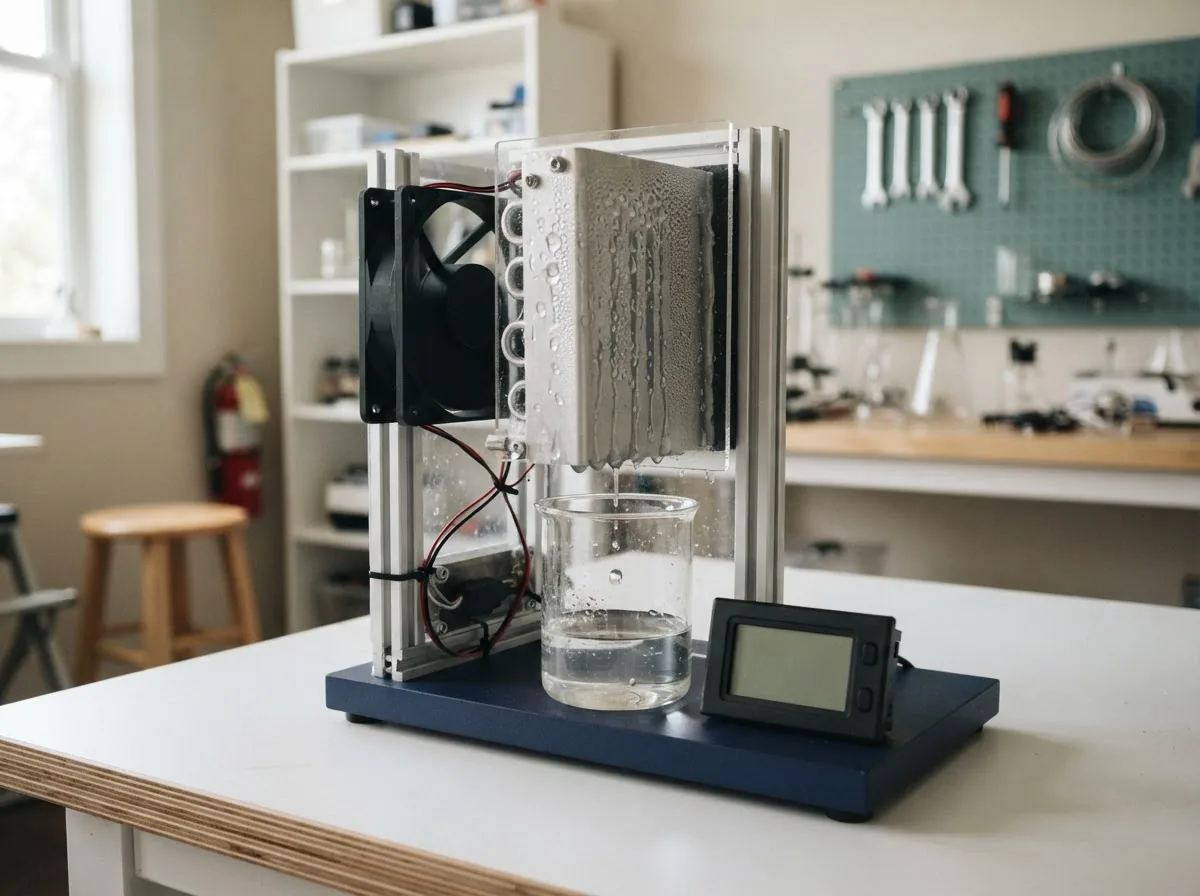
A DIY atmospheric water generator is a homemade system that collects moisture from ambient air and condenses or otherwise captures it as liquid water. DIY systems may use cooling-based condensation, passive dew collection, or other moisture-capture approaches. Output varies strongly with environmental conditions and design — warm, humid air yields more water than cold, dry air. Importantly, collected water requires appropriate treatment, sanitation, storage, and testing if it is intended for drinking.
An atmospheric water generator (AWG) extracts water vapor from the air around us. The core idea is straightforward: air always contains some amount of invisible water vapor, and if you cool that air enough — or expose it to the right capture medium — the vapor turns back into liquid water.
Here is the process in plain English:
Yes, it is technically possible to make water from air at home. The question is not whether it can be done but how much water a given setup can realistically produce — and that answer changes dramatically depending on where you live and how your system is built.
Several factors determine real-world performance:
Reality Check
The exact components depend on the moisture-capture method you choose, but most condensation-based DIY systems share a common set of functional parts. The table below describes each category at an educational level — it is not a wiring guide or a construction manual.
Note: This section explains concepts only. It does not provide electrical wiring instructions or unsafe construction steps. Always consult qualified professionals and manufacturer documentation for any powered equipment.
| Component Category | Purpose |
|---|---|
| Air movement | Moves humid air across the cooling or capture surface |
| Cooling / moisture capture | Lowers air temperature below its dew point or captures moisture |
| Condensation surface | Provides a clean surface where water vapor turns to liquid |
| Collection container | Holds condensed water; should be food-safe and cleanable |
| Tubing | Channels water from the condensation surface to storage |
| Power supply | Powers fans, cooling components, or pumps as applicable |
| Humidity monitoring | Tracks relative humidity and temperature to estimate conditions |
| Water treatment | Filtration or disinfection to make collected water safer to use |
| Sanitation | Cleaning schedules for collection surfaces and containers |
| Water-quality testing | Confirms whether treated water meets safety expectations |
The following is a high-level educational overview of the process. It is not a detailed build manual. Each step is described conceptually so you understand the sequence of decisions involved.
This process does not automatically produce drinking water. Every collected sample must be treated and tested before consumption.
This is one of the most common questions, and the honest answer is: yes, but only in small amounts. Several approaches can capture water from air without plugging anything into a wall outlet.
The key limitation is scale. Many high-output condensation systems require energy because cooling large volumes of air demands significant power. A passive setup can supplement your water supply in favorable conditions, but it is unlikely to provide meaningful household-scale output on its own.
Coming soon: Solar Atmospheric Water Generator Guide
A DIY build and a commercial AWG serve different needs. The comparison below is neutral — neither option is universally better. The right choice depends on your goals, budget, and technical comfort.
| Factor | DIY | Commercial AWG |
|---|---|---|
| Upfront cost | Varies; can be lower for small builds | Generally higher; priced by capacity |
| Customization | High — you control every component | Limited to manufacturer configurations |
| Ease of setup | Requires research, sourcing, and assembly | Typically ready to operate |
| Published specifications | You must measure performance yourself | Manufacturer provides rated specs |
| Maintenance | You handle all repairs and cleaning | Often supported by warranty or service |
| Troubleshooting | You diagnose and fix issues | Manufacturer support may be available |
| Filtration integration | You select and install treatment | Often built-in filtration systems |
| Performance predictability | Less predictable; depends on your build | More predictable under rated conditions |
| Best suited for | Learning, experimentation, supplemental use | Households wanting rated output |
It is difficult to give a single cost figure because total expense depends heavily on the scale of your build and whether you already own some components. Instead of inventing exact prices, here are the cost categories you should budget for:
A small experimental build using parts you already have may cost very little. A larger, more capable system with dedicated cooling, power, and treatment can cost significantly more. The most useful exercise is to list the components you need for your specific design and price them individually.
Coming soon: Atmospheric Water Generator Price Guide
If there is one variable that shapes atmospheric water generation more than any other, it is humidity. Understanding how humidity, temperature, and dew point interact helps you set realistic expectations. For a plain-language overview, see NOAA's explanation of humidity and dew point.
| Condition | Expected Relative Difficulty |
|---|---|
| Warm + humid | More favorable for condensation |
| Warm + dry | More difficult |
| Cool + humid | Possible but cooling dynamics differ |
| Cold + dry | Generally challenging |
No condition guarantees a specific gallon output. These are relative comparisons only. For a broader look at the different methods of capturing moisture from air, see our guide on how to make water from air.
What Affects Atmospheric Water Generation?
Humidity
Warm, humid air holds more water vapor, making condensation more productive. Dry air contains less moisture to capture.
Temperature
Warmer air holds more vapor, but cooling it to the dew point requires more energy. Temperature swings change daily output.
Airflow & System Design
Moving enough humid air across the cooling surface is essential. System size, efficiency, and maintenance all affect results.
Available Energy
Condensation-based systems use power to cool air. Energy availability, cost, and source (grid, solar, battery) shape output.
No factor guarantees a specific gallon output. Actual production varies with environmental conditions, system design, and operating conditions.
This is the most important section on this page. The short answer: collected water should not automatically be assumed potable. Just because water looks clear does not mean it is safe to drink.
Several issues can affect water collected from air:
Important Water Safety Note
Free Interactive Planner
Use the free 14-Day Family Water Backup Planner to calculate your household target, compare it with what you currently have stored, identify your biggest planning gaps, and build a personalized action plan.
Build My Free Water Plan →Free interactive 14-Day Family Water Backup Planner
A DIY atmospheric water generator is not a complete preparedness solution on its own. It works best as one layer in a broader household water plan. Here is a practical layered approach:
Layer 1 — Stored Water
A reserve of clean water you keep on hand before any disruption occurs. This is your most reliable immediate source.
Layer 2 — Treatment Capability
The ability to filter, disinfect, or otherwise make water from any source safer to use.
Layer 3 — Alternative Sources
Backup ways to obtain water, such as rainwater collection or — potentially — atmospheric water generation.
Layer 4 — Household Response Plan
A clear plan covering who does what, how water is rationed, and how the plan is practiced before it is needed.
Atmospheric water generation can potentially serve as one alternative source within this layered approach, rather than being the entire plan. Relying on a single method — any single method — leaves you more exposed than combining several. For more on building a resilient household, see our Preparedness & Healthy Home guides and our guide to building an emergency water supply for home.
If you are considering a DIY setup for your home, think through the practical realities of operating it indoors or in a semi-enclosed space like a garage or utility area.
For a deeper look at home-specific considerations, see our guide: atmospheric water generator for home use — covering practicality, humidity, power consumption, noise, maintenance, cost, and buying considerations.
Off-grid water generation is possible, but it adds another layer of complexity: you must produce or store the energy your system needs.
Learn more in our guide: Off-Grid Water System Guide.
You do not need to buy every item below to understand atmospheric water generation. These are practical examples of tools that can help measure conditions, test results, manage collection and storage, or evaluate backup power needs.
Disclosure: This section contains affiliate links. As an Amazon Associate I earn from qualifying purchases.
A simple humidity and temperature monitor can help you understand the environmental conditions that strongly affect condensation-based water-from-air experiments.
Check Current Price →Useful for basic at-home screening of several water-quality characteristics when evaluating collected or stored water. A consumer test-strip kit does not prove water is completely safe or potable, and does not replace professional laboratory testing where laboratory testing is appropriate.
Check Current Price →Food-grade silicone tubing is one example of tubing that may be useful when designing a controlled collection or transfer path in a DIY experiment. Using this tubing alone does not make collected water safe to drink.
Check Current Price →A collapsible water container provides a compact storage option for backup-water planning when storage space matters.
Check Current Price →Portable power can be relevant when evaluating electrically powered condensation equipment or other household backup systems where grid power may not always be available. Actual compatibility depends on equipment wattage, startup/surge requirements, operating time, battery capacity, and charging conditions — this power station cannot run every atmospheric water generator.
Check Current Price →DIY Water-From-Air Resource
If you are interested in going beyond the basic concepts in this guide, there is a separate step-by-step DIY water-from-air presentation you can review. It focuses on a DIY approach rather than purchasing a complete commercial atmospheric water generator.
Before deciding whether it fits your household, consider your local humidity, temperature, power availability, materials, maintenance requirements and water-treatment needs.
See the DIY Water-From-Air Guide →
Affiliate disclosure: We may earn a commission if you purchase through links on this page, at no additional cost to you.
Understanding where DIY builds commonly go wrong helps you avoid the same pitfalls. Here are the mistakes we see most often:
A DIY atmospheric water generator is a homemade system that collects moisture from ambient air and condenses or otherwise captures it as liquid water. Unlike a commercial unit, a DIY build is assembled by the user and may use cooling-based condensation, passive dew collection, or other moisture-capture methods. Output and safety depend entirely on design, climate, and maintenance.
An atmospheric water generator draws humid air across a cooled surface or other moisture-capture medium. When air cools below its dew point, water vapor condenses into liquid droplets that are collected, then optionally filtered or treated. Key factors include airflow, the temperature difference between air and the cooling surface, humidity, and how efficiently the system captures and stores the resulting water.
Yes, it is technically possible to make water from air at home using a condensation-based or passive approach. However, the amount of water you can produce varies dramatically with local humidity, temperature, system size, and power availability. A DIY setup is best understood as a supplemental or experimental source rather than a guaranteed household supply.
You can collect small amounts of water from air without electricity using passive condensation, dew collection surfaces, or desiccant-based concepts. However, these methods typically produce very limited output and are highly climate-dependent. Higher-output condensation systems generally require energy to power fans, cooling components, or pumps.
There is no single answer. Output depends on relative humidity, temperature, dew point, airflow, cooling capacity, system efficiency, and how many hours per day the system runs. A small DIY build in a warm, humid environment may collect noticeably more water than the same build in a cold, dry climate. We do not provide guaranteed gallon figures because performance is too variable.
Yes, humidity is one of the most important variables. Warm, humid air holds more water vapor, which makes condensation more productive. In cool or dry conditions, the air contains less moisture and the system must work harder to extract the same amount of water. Seasonal and daily humidity swings can significantly change output.
Total cost depends heavily on scale, the moisture-capture method you choose, and whether you already own components like fans, power supplies, or containers. Cost categories include cooling or moisture-capture equipment, fans, power, collection materials, tubing, filtration or treatment, water-quality testing, and ongoing maintenance. A small experimental build costs far less than a larger, more capable setup.
Not automatically. Water collected from air can pick up airborne contaminants, and collection surfaces or storage containers can introduce microbial growth. If water is intended for drinking, use food-safe materials, appropriate treatment and disinfection, and water-quality testing. Follow manufacturer instructions and applicable public-health guidance. Clear-looking water is not necessarily safe water.
An atmospheric water generator can work off grid if you have a reliable power source such as solar panels and battery storage. Because condensation-based systems can be energy-intensive, you need to size your power system to match the energy demand of fans, cooling components, and any pumps. Off-grid use also requires planning for maintenance and redundancy.
Solar power can run an atmospheric water generator, but the system must be sized to handle the energy demand of cooling and airflow components. A solar-assisted setup typically needs battery storage to operate consistently, since production depends on having power available during humid conditions, which may not always align with peak sunlight hours.
A dehumidifier and a condensation-based atmospheric water generator both remove moisture from air, but they are designed for different purposes. A dehumidifier is built to reduce indoor humidity and its collected water is generally not intended for consumption. An atmospheric water generator is designed with collection, filtration, and storage aimed at producing water for use, though any collected water still requires appropriate treatment before drinking.
That depends on your goals, climate, and budget. A DIY build can be a worthwhile educational project and a supplemental backup source in the right conditions. However, if you need predictable, larger-scale output, a commercial unit or other backup-water options may be more practical. Evaluate your local humidity, energy costs, and water needs before investing significant time or money.
Store collected water in food-safe, clean containers kept away from heat and direct sunlight. Seal containers to prevent contamination, label them with the collection date, and rotate stored water regularly. Even properly collected water should be treated and tested if it will be used for drinking, and storage containers should be sanitized on a regular schedule.
They can work in dry climates, but output is typically much lower because dry air holds less water vapor. In arid conditions, the system must process far more air to capture the same amount of water, which increases energy use and reduces efficiency. Passive methods are especially limited in dry environments.
A resilient plan combines stored water, treatment capability, and multiple backup sources. Options include stored bottled water, rainwater collection, a gravity or pump filter, water purification tablets, and a household response plan. Atmospheric water generation can be one supplemental source within this layered approach rather than a standalone solution.
Knowing how water-from-air works is useful. Knowing exactly what your own household needs is even more useful. Use the free planner to calculate your target and identify the gaps in your current backup plan.
Start My Free 14-Day Water Plan →