Water From Air Explained
How to Make Water From Air at Home: What Actually Works?
Learn how condensation, dew collection, desiccants, cooling systems, and other methods can capture moisture from air — plus the limitations that matter in real-world use.
Free interactive 14-Day Family Water Backup Planner
Independent educational guide • Climate matters • Water safety matters
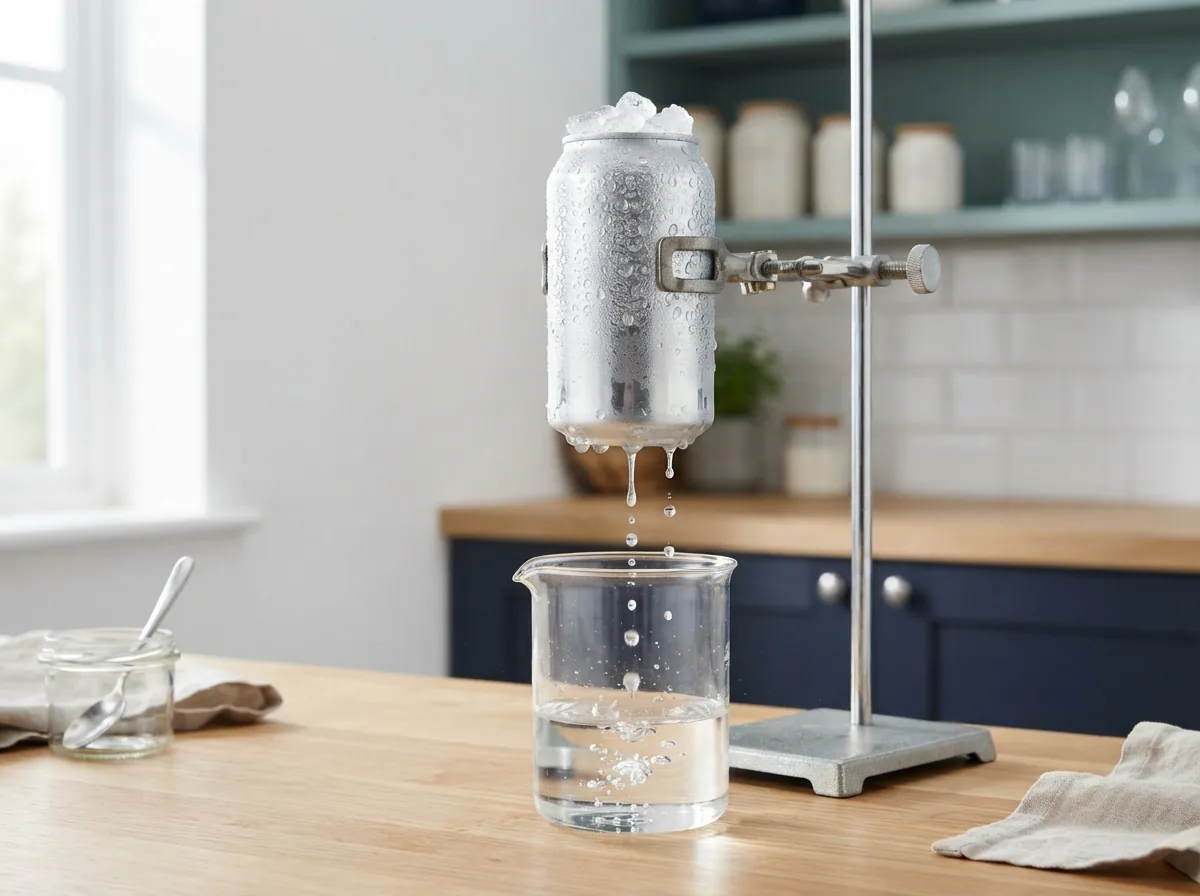
Can You Really Make Water From Air?
Yes. Water vapor naturally exists in the air around us, and it can be captured through several methods including condensation, dew collection, desiccants, fog collection, and powered atmospheric water generation. Actual water yield depends heavily on humidity, temperature, surface conditions, equipment, energy, and climate. Importantly, collected water should not automatically be assumed safe to drink — it requires appropriate treatment, storage, and testing.
Where Does Water in the Air Come From?
Before understanding how to make water from air, it helps to understand what is already there. The air around you contains water in a gaseous form called water vapor. This vapor enters the air through evaporation — from oceans, lakes, rivers, soil, plants, and even your own breath. You cannot see it, but it is present almost everywhere.
The amount of water vapor air can hold depends on temperature. Warm air holds more water vapor than cold air. When we talk about how much moisture is in the air, we use a few key terms:
- Water vapor: Water in its invisible, gaseous state, mixed into the air.
- Humidity: A general term for the amount of moisture in the air.
- Relative humidity (RH): The percentage of water vapor currently in the air compared to the maximum it could hold at that temperature. At 100% RH, air is saturated.
- Dew point: The temperature at which air becomes saturated and water vapor begins to condense into liquid. If air cools below its dew point, water appears.
These concepts — water vapor, humidity, and dew point — are the foundation for every method of collecting water from air. Whether you use a powered cooling system or a passive surface, you are working with the same physics.
The Simplest Principle: Condensation
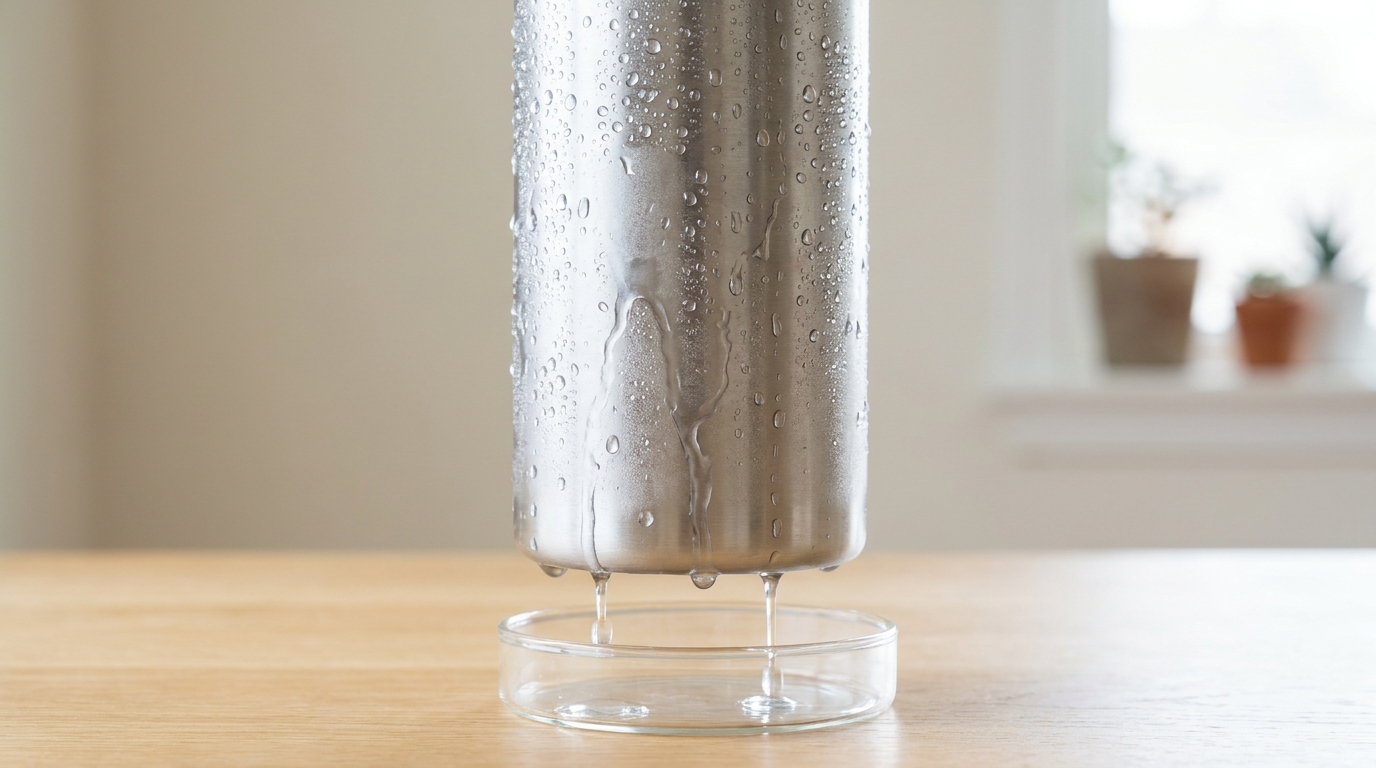
You have already seen water from air in action. On a warm, humid day, pour cold water into a drinking glass. Within minutes, droplets form on the outside of the glass. That water did not seep through the glass — it came from the air. The cold surface cooled the surrounding air below its dew point, causing water vapor to condense into liquid droplets.
The same principle is at work in several familiar places:
- Cold drinking glass: Condensation forms on the outside when humid air meets a cold surface.
- Air-conditioner coil: AC units cool indoor air, and moisture condenses on the cold evaporator coil. That condensate is usually drained away.
- Dehumidifier: A dehumidifier deliberately cools air to remove moisture, collecting water in a tank — though that water is generally not intended for drinking.
- Cold metal surface: Any surface colder than the dew point of the surrounding air will collect condensation.
Important Note
Method 1: Cooling and Condensation
The most common way to make water from air is cooling-based condensation. This is the method used by most commercial atmospheric water generators and many DIY setups. The process works as follows:
- Air movement: A fan draws humid air into the system and moves it across a cooling surface.
- Cooling surface: A metal coil, plate, or other surface is kept cold — usually by a refrigeration cycle — below the dew point of the incoming air.
- Dew point: When humid air contacts the cold surface, it cools below its dew point, and water vapor condenses into liquid droplets.
- Condensation: Droplets form on the cold surface and grow large enough to run downward.
- Collection: Droplets are channeled into a collection tray or container.
This method can produce meaningful amounts of water in warm, humid conditions, but it requires energy to run the cooling system and fans. In cool or dry air, the system must process much more air to collect the same amount of water, which increases energy use and reduces efficiency.
For a deeper dive into building your own cooling-based system, see our complete DIY atmospheric water generator guide. If you are evaluating a residential unit rather than building one, our atmospheric water generator for home guide covers practicality, power, noise, and buying considerations.
TempPro TP50 Digital Hygrometer Indoor Thermometer
A simple hygrometer can help you understand your local temperature and relative humidity before evaluating whether condensation-based water collection is practical.
Check Current Price →Disclosure: This section contains affiliate links. As an Amazon Associate I earn from qualifying purchases.
Method 2: Passive Dew Collection
Passive dew collection does not use electricity. Instead, it relies on natural temperature changes to cool a surface below the dew point so that moisture condenses overnight. This is one of the simplest ways to collect water from air without power.
The key concepts are:
- Radiative cooling: At night, certain surfaces radiate heat into the sky and cool below the surrounding air temperature. A metal sheet or foil-lined surface can become cold enough to collect dew.
- Nighttime temperature changes: Dew forms when nighttime temperatures drop and humid air meets a surface that has cooled below the dew point.
- Surface cooling: The collection surface should have good thermal properties — it cools quickly and stays cold long enough for condensation to occur.
- Dew formation: Droplets form on the cooled surface and are channeled into a container by gravity or surface texture.
- Climate dependence: This method works best in areas with significant night-to-day temperature swings and moderate to high humidity. In consistently warm or dry conditions, yield drops sharply.
Be realistic about quantities. Passive dew collection can produce small amounts of water — enough to demonstrate the principle or supplement other sources — but it is unlikely to meet meaningful household needs on its own. The amount collected depends on surface area, humidity, nighttime temperature drop, and how many collection surfaces you have.
Can You Make Water From Air Without Electricity?
This is one of the most searched questions on this topic, and the honest answer is: yes, but only in limited amounts. Several methods can capture water from air without plugging anything into a wall outlet.
- Passive dew collection: Uses nighttime radiative cooling to condense moisture on a surface. No power needed, but output is small and climate-dependent.
- Fog collection: Uses mesh nets to capture water droplets from fog. Works without electricity but only in areas with frequent, persistent fog.
- Desiccant approaches: Certain materials absorb moisture from air and release it when heated. The absorption step needs no electricity, but releasing the water typically requires heat.
- Solar-assisted systems: Solar heat can drive the regeneration of desiccants or power small fans. These blur the line between passive and active but still rely on sunlight availability.
- Radiative cooling surfaces: Specially designed surfaces that cool below ambient temperature through thermal radiation can collect dew without power, though yield is modest.
The key limitation is scale. Many high-output condensation systems require energy because cooling large volumes of air demands significant power. A passive setup can supplement your water supply in favorable conditions, but it is unlikely to provide meaningful household-scale output on its own. Do not assume a passive system will reliably meet daily household water needs.
Can Sunlight Help Make Water From Air?
Sunlight does not magically create water. The water comes from atmospheric humidity. What sunlight can do is supply energy to a moisture-capture process. There are three distinct concepts to understand:
1. Solar electricity powering condensation equipment
Solar panels generate electricity that runs fans and cooling components in a condensation-based system. Battery storage is usually needed because humidity often peaks when sunlight does not.
2. Solar heat regenerating desiccants
A desiccant absorbs moisture from air overnight. During the day, concentrated sunlight heats the desiccant to release the captured moisture, which then condenses into a collection container.
3. Solar-assisted passive collection
Some designs use solar heating and shading to create temperature differences that drive condensation. These are experimental and produce limited output.
In all three cases, sunlight provides energy — not water. The water always comes from the air. Understanding this distinction helps you evaluate claims about solar water-from-air devices more critically.
Method 3: Desiccant-Based Water Collection
Desiccants are materials that absorb or adsorb moisture from the air. Silica gel, certain salts, and other compounds can pull water vapor from ambient air. Once the desiccant is saturated, the captured moisture can be released by applying heat — and that released vapor can then be condensed into liquid water.
The basic cycle works like this:
- Moisture absorption / adsorption: The desiccant is exposed to humid air and captures water vapor from it.
- Regeneration: The saturated desiccant is heated — using solar heat, a heat source, or another method — which drives the captured moisture out as vapor.
- Release of moisture: The released water vapor is directed to a cooler surface or condensation chamber.
- Condensation: The vapor condenses back into liquid water and is collected.
This method is interesting because the absorption step can work without electricity. However, the regeneration step typically requires heat, and the cycle is slow compared to powered condensation. Output is usually modest.
Note: This section explains the concept at an educational level. It does not provide chemical handling instructions or unsafe DIY chemistry guidance. Always follow manufacturer safety data and applicable handling instructions for any desiccant material.
Method 4: Fog Collection
Fog collection is different from the other methods on this page because it captures water that is already in liquid droplet form — not invisible water vapor. Fog is essentially a cloud at ground level: tiny water droplets suspended in air. When fog passes through a fine mesh, those droplets stick to the fibers, merge into larger drops, and run down into a collection trough.
Key points about fog collection:
- Fog droplets vs. water vapor: Fog is made of visible liquid droplets. Water vapor is invisible. Fog collection captures droplets directly; condensation captures vapor by cooling it.
- Mesh collection: Fine mesh nets — typically made of polypropylene or similar material — are suspended on supports in fog-prone areas.
- Suitable climates: Fog collection works only where fog is frequent and persistent — usually coastal mountains, certain islands, or high-elevation cloud forests.
- Limitations: If your area rarely gets fog, this method will not produce meaningful water. It is highly location-specific.
- Maintenance: Mesh can be damaged by wind, UV exposure, and debris. Regular inspection and replacement are needed.
Fog collection is one of the few methods that can produce water without electricity in the right climate. But the right climate is the critical qualifier — it does not work everywhere.
Can You Make Water From Air With Plastic Bottles?
This question appears frequently in search results, often tied to viral videos claiming that plastic bottles can produce drinking water from air. Here is the honest answer.
A plastic bottle can demonstrate condensation or solar effects. For example, if you place a bottle in a warm, humid environment and then cool it, condensation may form on the inside surface. Similarly, some solar still designs use plastic containers to capture evaporation and condensation from a small water source inside the container.
However, a plastic bottle itself does not create meaningful quantities of water from dry air. The water you see in these demonstrations comes from humidity that was already present, or from a water source inside the container — not from the bottle magically generating water. Viral hacks that imply otherwise are misleading.
If you want to understand the real methods of collecting water from air, focus on the four approaches described above: cooling and condensation, passive dew collection, desiccant-based collection, and fog collection. Each has real physics behind it. A plastic bottle is a demonstration tool, not a water generator.
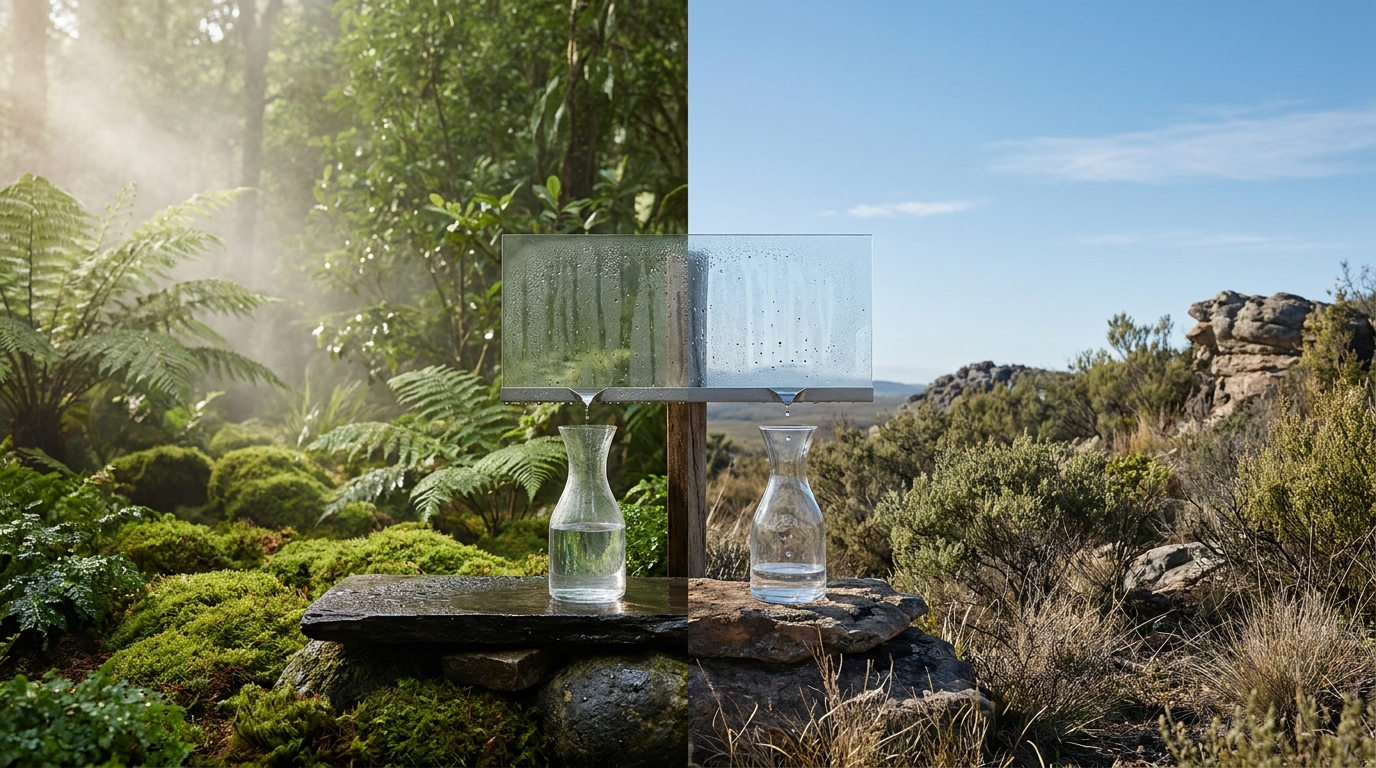
What Conditions Make Collecting Water From Air Easier?
The same method can produce very different amounts of water depending on where and when you use it. Several environmental factors determine how productive water collection from air will be.
Warm + Humid
Generally more favorable
Warm + Dry
More difficult
Cool + Humid
Depends strongly on method
Cold + Dry
Generally difficult
| Condition | Relative Difficulty |
|---|---|
| Warm + humid | Generally more favorable |
| Warm + dry | More difficult |
| Cool + humid | Depends strongly on method |
| Cold + dry | Generally difficult |
The main factors at play:
- Humidity: Higher relative humidity means more water vapor is available to capture.
- Temperature: Warm air holds more vapor than cold air, but cooling it to the dew point also requires more energy.
- Dew point: A higher dew point means your cooling surface does not need to be as cold to produce condensation.
- Airflow: Moving fresh humid air across the collection surface keeps the process going.
- Surface temperature: The colder the collection surface relative to the dew point, the more condensation occurs.
How Much Water Can You Realistically Collect From Air?
There is no universal number. The amount of water you can collect from air depends on so many interacting variables that any single figure would be misleading. Instead of promising a gallon count, here are the factors that determine realistic output:
- Humidity: The amount of water vapor in the air sets the upper limit on what can be captured.
- Temperature: Warmer air holds more vapor, but cooling it requires more energy.
- Air volume: How much air passes across the collection surface per hour affects total yield.
- Surface area: Larger collection surfaces capture more condensation.
- Equipment: System design, cooling capacity, and efficiency all matter.
- Runtime: How many hours per day the system operates directly affects total output.
- Energy input: Powered systems need enough energy to maintain the cooling surface below the dew point.
- Efficiency: How well the system transfers heat and captures condensation determines water per unit of energy.
A small passive dew collector might yield a few ounces per night. A powered condensation system in a warm, humid climate might collect more. But the same system in a cold, dry climate might produce very little. We do not invent gallon guarantees because performance is too variable. The most useful approach is to measure output under your actual conditions.
| Method | Power | Best Climate | Scale |
|---|---|---|---|
| Cooling / Condensation | Powered (usually) | Warm, humid | Moderate to high |
| Passive Dew Collection | No electricity | Cool nights, moderate humidity | Very low |
| Desiccant-Based | Heat needed for regeneration | Variable | Low to moderate |
| Fog Collection | No electricity | Foggy coastal/mountain | Variable |
Is Water Collected From Air Safe to Drink?
This is the most important question on this page. The short answer: collected water should not automatically be assumed potable. Just because water looks clear does not mean it is safe to drink.
Several issues can affect water collected from air:
- Airborne contaminants: Dust, pollen, pollutants, and particulates in the air can be captured along with water vapor.
- Collection-surface contamination: Any dirt, residue, or microbial growth on the condensation surface ends up in your water.
- Microbial growth: Warm, moist surfaces and storage containers can harbor bacteria or biofilm if not cleaned regularly.
- Storage: Even clean water can be compromised by unclean containers or prolonged storage.
- Materials: Non-food-safe plastics or metals can leach substances into collected water.
- Sanitation: Without regular cleaning, collection and storage components can become sources of contamination.
- Treatment: Filtration, disinfection, or other treatment may be needed before water is used for drinking.
- Testing: Water-quality testing is the only way to confirm whether collected water meets safety expectations.
Clear Does Not Mean Potable
17-in-1 Complete Drinking Water Test Kit
A consumer water-testing kit can help screen several common water characteristics, but it should not be presented as proof that an unknown water source is completely safe to drink.
Check Current Price →Disclosure: This section contains affiliate links. As an Amazon Associate I earn from qualifying purchases.
Materials Matter When Collecting Water
The materials you use to collect, route, and store water from air directly affect water quality. Even if condensation itself is relatively clean, the wrong materials can introduce contamination.
- Food-safe collection materials: Collection surfaces and containers should be made from food-grade materials that do not leach harmful substances.
- Clean tubing: Any tubing used to route water from the collection surface to storage should be food-grade and cleaned regularly.
- Covered containers: Storage containers should be covered to prevent dust, insects, and airborne contaminants from entering.
- Sanitation: Collection surfaces, tubing, and containers should be cleaned on a regular schedule to prevent microbial growth.
- Avoiding contamination: Do not use containers that previously held non-food substances, and avoid materials that corrode or degrade with moisture.
JoyTube Food Grade Silicone Tubing — 1/4" ID x 3/8" OD, 10 ft
Food-grade silicone tubing is one example of tubing that may be useful for routing collected water in a controlled water-from-air experiment.
Check Current Price →Disclosure: This section contains affiliate links. As an Amazon Associate I earn from qualifying purchases.
How Should Collected Water Be Stored?
Once water is collected, storage is the next critical step. Poor storage can undo the benefits of careful collection.
- Clean containers: Use food-safe containers that have been sanitized before filling.
- Covered storage: Seal containers to prevent contamination from dust, insects, and airborne particles.
- Sanitation: Clean and sanitize storage containers on a regular schedule, not just before first use.
- Rotation: Rotate stored water regularly rather than letting it sit indefinitely. Stagnant water can develop microbial growth.
- Avoiding stagnant water: Do not let collected water sit in open containers or collection trays for extended periods.
WaterStorageCube Collapsible Water Container with Spigot — 2.6 Gal, 2-Pack
A collapsible water container provides flexible backup storage where household storage space is limited.
Check Current Price →Disclosure: This section contains affiliate links. As an Amazon Associate I earn from qualifying purchases.
Free Interactive Water Planner
Making Water Is Only One Part of a Household Backup Plan
Use the free 14-Day Family Water Backup Planner to calculate your household target, compare it with what you currently have stored, and identify your biggest planning gaps.
Build My Free Water Plan →Free interactive 14-Day Family Water Backup Planner
- Personalized household water target
- Current water-gap calculation
- Water Readiness Score
- Storage and treatment checklist
- Backup-source planning
- Personalized 14-day action plan
- Printable planner sent by email
Water From Air vs Stored Water
Both approaches have a place in a household backup plan, but they serve different roles. Here is a neutral comparison:
- Predictability: Stored water is immediately available and predictable. Water from air depends on environmental conditions and equipment.
- Energy dependence: Stored water needs no energy to access. Powered water-from-air systems need electricity or another energy source.
- Storage space: Stored water requires physical space. Water-from-air systems produce water on demand but still need collection and storage containers.
- Climate dependence: Stored water works anywhere. Water from air is strongly affected by humidity and temperature.
- Maintenance: Stored water needs container rotation and cleaning. Water-from-air systems need ongoing maintenance of collection surfaces, filters, and storage.
- Treatment: Both may require treatment before drinking, depending on source and storage conditions.
The most resilient approach combines both: store water for immediate, predictable access, and have the capability to produce or collect more if a disruption lasts longer than your stored supply.
Water From Air vs Rainwater Collection
Rainwater collection and atmospheric water generation are both alternative water sources, but they work very differently.
- Climate: Rainwater depends on rainfall patterns. Water from air depends on humidity and temperature.
- Rainfall: Rainwater can provide large volumes quickly during a storm, but is intermittent. Water from air produces smaller, more continuous amounts.
- Storage: Rainwater requires significant storage capacity to bridge dry periods. Water-from-air systems produce water as conditions allow.
- Collection surfaces: Rainwater uses roofs, gutters, and catchment areas. Water from air uses cooling surfaces, meshes, or desiccants.
- Treatment: Both require treatment before drinking. Rainwater can pick up contaminants from roof surfaces and gutters.
- Local rules: Rainwater collection is regulated in some areas. Check local regulations before installing a rainwater system.
In some climates, rainwater collection may be more practical than atmospheric water generation. In others — particularly humid areas with unreliable rainfall — water from air may be a useful supplement. They are not mutually exclusive.
Water From Air vs a Well
A well taps into groundwater, while an atmospheric water generator taps into air moisture. These are fundamentally different water sources with different requirements.
- Groundwater access: A well provides access to water stored underground. Water from air accesses moisture in the atmosphere.
- Infrastructure: A well requires drilling, casing, a pump, and plumbing. A water-from-air system requires collection equipment and power.
- Power: Wells need power for pumping. Powered AWG systems need energy for cooling and airflow.
- Maintenance: Wells need pump maintenance and water testing. Water-from-air systems need surface cleaning, filter changes, and sanitation.
- Testing: Both require regular water-quality testing before consumption.
- Site suitability: Wells depend on groundwater availability and depth. Water from air depends on atmospheric humidity.
A well can be a reliable, high-volume water source in the right location. Water from air is typically a supplemental source. If you have access to a viable well, it will likely outproduce an atmospheric water generator — but wells have their own costs, maintenance, and site requirements.
Which Water-From-Air Method Makes Sense at Home?
The right approach depends on what you are trying to accomplish. Here is a simple decision guide:
If you want to understand DIY equipment and build a concept:
See our DIY atmospheric water generator guide — covering components, step-by-step overview, costs, and limitations.
If you are evaluating residential equipment for home use:
See our atmospheric water generator for home guide — covering practicality, power, noise, maintenance, and buying considerations.
If you are planning for an off-grid property:
See our off-grid water system guide — covering power, redundancy, and independent water sources.
If you are planning emergency household water:
See our emergency water supply for home guide — covering storage, treatment, and household planning.
DIY Water-From-Air Resource
Want to Explore a More Detailed DIY Water-From-Air Approach?
If you want to go beyond the basic methods described above, there is a separate DIY water-from-air presentation you can review.
Before deciding whether it fits your situation, consider humidity, climate, energy availability, materials, maintenance, and water-treatment needs.
See the DIY Water-From-Air Approach →
Affiliate disclosure: We may earn a commission if you purchase through links on this page, at no additional cost to you.
Frequently Asked Questions
Can you really make water from air?
Yes. Air contains invisible water vapor, and several methods — condensation, dew collection, desiccants, fog collection, and powered atmospheric water generation — can capture that moisture as liquid water. How much water you get depends heavily on humidity, temperature, surface conditions, equipment, and energy.
How do you turn air into water?
The most common way is condensation: cool humid air below its dew point so water vapor turns into liquid droplets on a cold surface. Other methods include passive dew collection, desiccant absorption and regeneration, and fog mesh collection. Each method captures moisture that already exists in the air.
Can you make water from air at home?
Yes, you can make water from air at home using a cooling-based condensation setup, a passive dew collector, or a small desiccant experiment. However, the amount of water produced varies dramatically with indoor humidity, temperature, and system size. Home experiments are best understood as educational or supplemental rather than a full household supply.
Can you make water from air without electricity?
You can collect small amounts of water without electricity using passive dew collection, fog mesh, or desiccant methods. However, passive systems typically produce limited quantities and depend heavily on climate. Higher-output condensation systems generally require energy to power fans and cooling components.
How do you collect water from air naturally?
Natural collection methods include dew that forms on cool surfaces overnight, fog droplets caught on mesh screens, and moisture absorbed by certain materials. These passive approaches work without electricity but produce relatively small amounts of water compared to powered condensation systems.
Can sunlight help make water from air?
Sunlight does not directly create water, but it can supply energy to a moisture-capture process. Solar panels can power condensation equipment, solar heat can regenerate desiccants to release captured moisture, and solar-assisted passive systems can aid collection. The water still comes from atmospheric humidity, not from sunlight itself.
Can plastic bottles collect water from air?
Plastic-bottle demonstrations can show condensation forming on surfaces, but a plastic bottle alone does not create meaningful quantities of water from dry air. Viral hacks that claim otherwise typically overstate what is happening. Condensation in these demos depends on temperature differences and ambient humidity, not the bottle itself.
How does condensation make water?
When warm, humid air meets a surface colder than the air's dew point, water vapor in the air turns into liquid droplets on that surface. This is the same process that forms water on the outside of a cold drinking glass on a humid day. Over time, those droplets collect and can be gathered into a container.
What humidity makes collecting water easier?
Higher relative humidity makes condensation-based collection easier because the air holds more water vapor. Warm, humid conditions are generally the most favorable. In cool or dry air, there is less moisture available, and the system must work harder to extract the same amount of water.
How much water can you collect from air?
There is no universal figure. The amount depends on humidity, temperature, air volume processed, surface area, equipment, runtime, energy input, and system efficiency. A small passive collector may yield a few ounces, while a powered system in a humid climate may collect more. We do not provide guaranteed gallon figures because performance is too variable.
Is water collected from air safe to drink?
Not automatically. Collected water can pick up airborne contaminants, and collection surfaces or storage containers can introduce microbial growth. If water is intended for drinking, use food-safe materials, appropriate treatment and disinfection, and water-quality testing. Clear-looking water is not necessarily safe water.
Is a dehumidifier the same as an atmospheric water generator?
No. Both remove moisture from air, but a dehumidifier is designed to reduce indoor humidity and its collected water is generally not intended for consumption. An atmospheric water generator is designed with collection, filtration, and storage aimed at producing water for use, though any collected water still requires appropriate treatment before drinking.
How does fog collection work?
Fog collection uses fine mesh nets suspended in foggy areas. When fog passes through the mesh, tiny water droplets stick to the fibers, merge, and run down into a collection trough. It works without electricity but requires frequent, persistent fog — typically in coastal or mountainous regions — and produces variable amounts depending on fog density.
What is the easiest way to demonstrate water from air?
The simplest demonstration is condensation on a cold surface: fill a glass with ice water on a humid day and watch droplets form on the outside. This shows the basic principle — cooling air below its dew point causes moisture to condense. It is educational but does not produce meaningful drinking water.
Can water from air be part of emergency preparedness?
Yes, atmospheric water generation can be one supplemental source within a layered emergency water plan. However, it should not replace stored water, treatment capability, or a household response plan. Output depends on environmental conditions, so relying on a single method leaves you more exposed than combining several approaches. For a complete household plan, see our emergency water supply for home guide.
Related Guides
DIY Atmospheric Water Generator
Complete step-by-step educational guide.
Read moreAtmospheric Water Generator for Home
Choosing a home water-from-air system.
Read moreOff-Grid Water System
Water independence beyond the grid.
Read moreEmergency Water Supply for Home
Building a household backup plan.
Read morePreparedness & Healthy Home
Practical guides for a more resilient household.
Read moreKnow Your Water Target Before Choosing a Backup Source
Before comparing equipment, know what your household actually needs. Use the free planner to calculate your 14-day target and identify your current backup-water gap.
Start My Free Water Plan →